
Mission 35: The Surprise in the Spit Kit — When DNA Tells You Something the Family Didn’t
Mission 35: The Surprise in the Spit Kit — When DNA Tells You Something the Family Didn’t
A lot of genealogists take a DNA test expecting a confirmation and get a question instead. Maybe a match that’s closer than the family tree accounts for. Maybe a parent-child relationship that the DNA doesn’t recognize the way the paperwork does. Maybe something else entirely, arriving quietly in a match list on an ordinary afternoon, with no warning that today was the day.
If that’s happened to you, or you’re bracing for the chance that it might, this mission is for you. You’re not alone in it — not nearly as alone as it feels in the moment — and there’s a right way to move through it.
Why This Isn’t a Footnote
Mission 11 taught you what a DNA test measures. Mission 23 taught you how to use matches to build out a family network. Neither mission covered what happens when the test measures something the family tree didn’t expect, because until it happens to you, or to someone you love, it’s hard to imagine that a spit sample could complicate a relationship you’d never thought to question.
It happens far more often than most people realize, and almost nobody warns you about it in advance. This mission is that warning — arriving a little late for some readers, and right on time for others. Here is what an unexpected result usually means, what it almost never means, and what to do before you do anything else.
How Common Is This, Really
Start with a number, because a number is more stabilizing than any reassurance I could offer in its place.
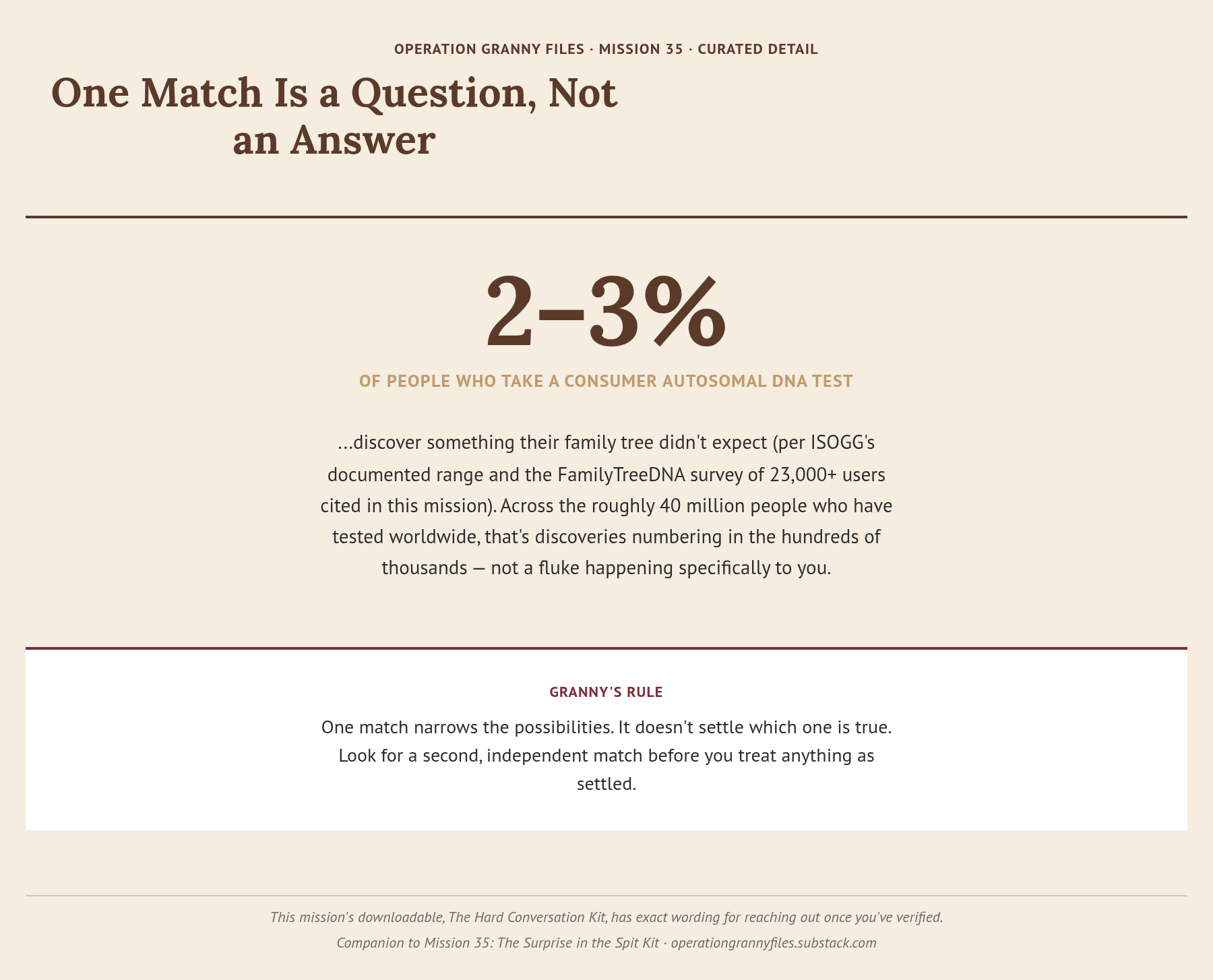
Estimates vary by study and population, but the figure genetic genealogists cite most consistently for the general population sits around 2 to 3 percent — and the International Society of Genetic Genealogy’s own wiki entry on unexpected results puts the full documented range at “less than 1 percent to more than 10 percent,” depending on the population studied. One of the more concrete anchors comes from a survey of over 23,000 FamilyTreeDNA users, which found that 3 percent had discovered an unexpected biological parent.
Run that percentage against the roughly 40 million people who have taken a consumer autosomal DNA test worldwide, and you’re looking at unexpected-parentage discoveries numbering in the hundreds of thousands — before you even count unexpected half-siblings, donor-conceived discoveries, or a cousin match that turns out to be much closer than the paper trail suggested. This is not a freak occurrence happening specifically to you. It’s a well-documented outcome of a technology used by tens of millions of people, and there’s now an entire body of research, peer support, and professional practice built around exactly this experience.
One Match Is a Question, Not an Answer
This is the point where Mission 19’s Genealogical Proof Standard stops being an abstract research principle and becomes something closer to an emotional safety rail. The Genealogical Proof Standard asks for reasonably exhaustive research, evidence that’s been correlated and resolved, and a conclusion that’s soundly reasoned — not a conclusion drawn from the first data point that startled you.
A single unexpectedly close match, on its own, narrows a range of possible explanations. It doesn’t settle which one is true. Some of those explanations are far more mundane than the one your mind reaches for first: endogamy in a small ancestral community can inflate shared centimorgans well past what a simple relationship chart predicts. A match may be testing under an account that doesn’t reflect who actually took the test. A half-relationship is easy to misread as something closer or more distant than it is. Databases make errors.
The Board for Certification of Genealogists’ standards for DNA evidence are explicit here: a genetic relationship conclusion should account for more than one possible common ancestor, should draw on enough testers and matches to rule out competing explanations, and should combine DNA evidence with documentary evidence rather than resting on DNA alone.
A confidence note, plainly stated: DNA evidence is direct evidence of a genetic relationship, and only indirect evidence of everything built on top of that relationship — who a person’s social parents were, what a family believed, what belongs in a family tree. Treat those as two different questions, verified separately, before you act on either one.
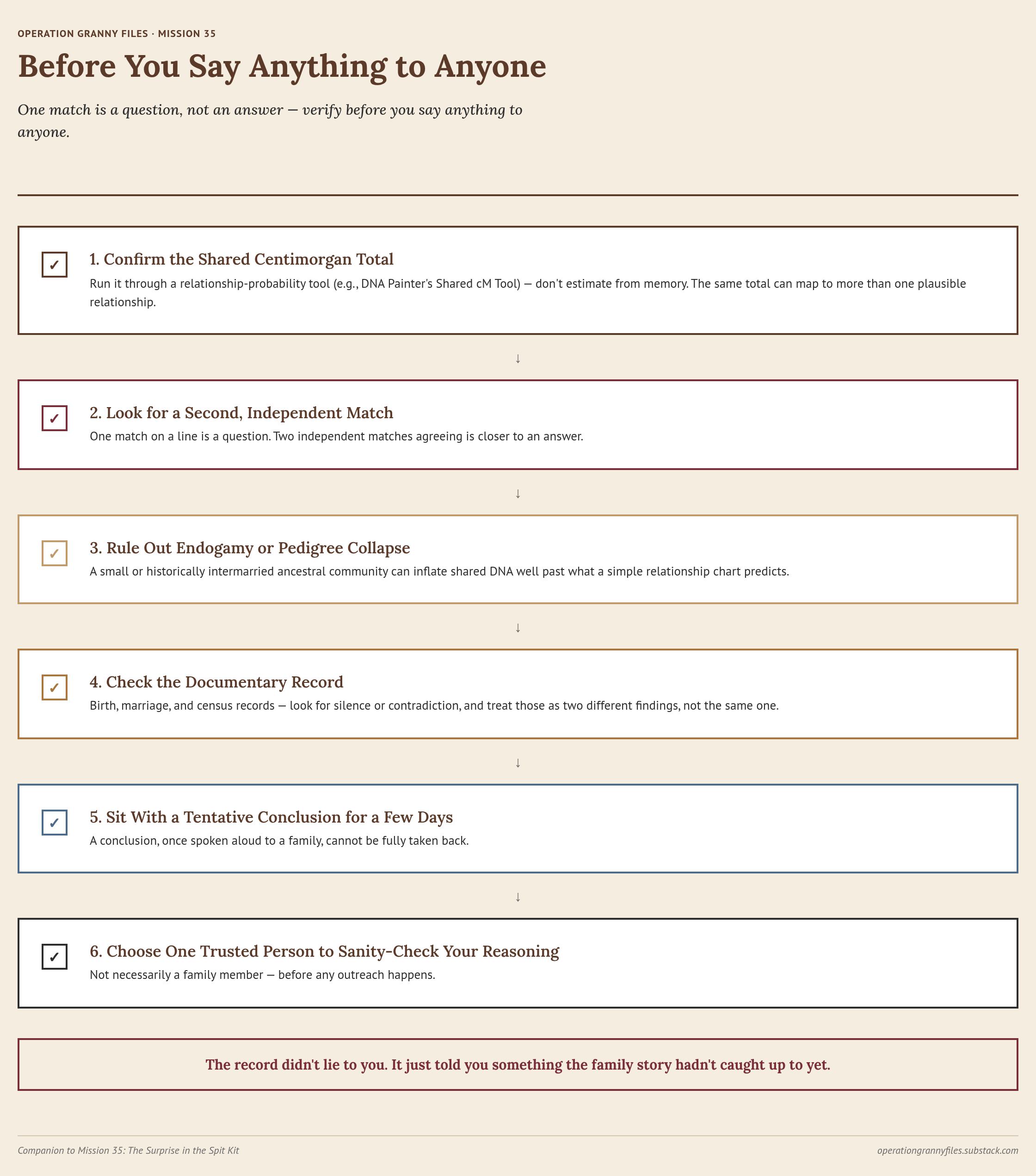
Here’s what that verification looks like as an actual sequence of steps, not just a principle. Take the shared centimorgan total your testing company reports and run it through a relationship-probability tool, such as DNA Painter’s Shared cM Tool, rather than eyeballing it against a chart from memory — the same total can map to more than one plausible relationship, and the tool will show you the full spread, not just the likeliest one. Look for a second match on the same line who corroborates the first; one match pointing somewhere is a lead, two independent matches agreeing is closer to evidence. Check whether the family’s ancestral community was small or historically intermarried, which can inflate shared DNA well past what an otherwise-unrelated relationship chart predicts. Then, and only then, look at what the documentary record says — does it stay silent where you’d expect a record, or does it actively contradict what the DNA suggests? Silence and contradiction are different findings, and they point toward different next steps.
None of this is slow because slowness is a virtue for its own sake. It’s slow because a conclusion, once spoken aloud to a family, cannot be fully taken back.
If You Decide to Reach Out
The actual wording for a message like this lives in this mission’s downloadable, The Hard Conversation Kit — what belongs here is the principle behind it, because the principle matters more than any specific phrasing.
A first message to an unexpected match should open a door. It should not kick one down. Genetic genealogist Diahan Southard’s widely used guidance frames a good first contact as calm, brief, and low-pressure: identification, a simple invitation to respond if and when they’re comfortable, nothing more urgent than that. The rule repeated across genetic-genealogy ethics writing, including the Board for Certification of Genealogists’ own guidance, is that specific permission should be secured before a DNA match is disclosed to anyone else, and that no one — including the person reaching out — is entitled to a relationship.
A match who doesn’t respond, or who responds and asks not to continue, is exercising a legitimate choice. That isn’t a rejection of your search. It’s a boundary, and it deserves the same respect you’d want extended to you.
What Belongs in a Shared Tree, and What Doesn’t
A discovery like this happens inside a family tree, and family trees today are shared, forked, and searched by people you’ll never meet. FamilySearch and Ancestry’s own guidance agrees on the basics: don’t add a living person to a public tree without their consent, and when in doubt, leave the identifying detail out. That guidance gets sharper here, because an unexpected result usually involves at least one living person — a parent, a sibling, sometimes your own parent — who hasn’t agreed to appear anywhere in connection with this discovery.
Here’s the principle, stated plainly rather than hedged: a discovery belongs, at first, only to the person who made it. It doesn’t automatically belong in a shared tree, a family group chat, or even a private-feeling post. Every person you tell, and every place you write it down, is a decision that reduces someone else’s control over their own story. Make that decision on purpose. Don’t let it happen by momentum.
Before You Say Anything to Anyone
- Confirm the shared centimorgan total and run it through a relationship-probability tool — don’t estimate from memory.
- Look for a second, independent match on the same line. One match is a question; two agreeing matches are closer to an answer.
- Rule out endogamy or pedigree collapse if the family’s ancestral community was small or intermarried.
- Check documentary records — birth, marriage, census — for silence or contradiction, and treat those as different findings.
- Sit with a tentative conclusion for a few days before acting on it or telling anyone.
- Choose one trusted person, not necessarily a family member, to sanity-check your reasoning before any outreach happens.
Where This Goes Wrong
You’ll treat a single match as a verdict instead of a data point, because a strong feeling in the moment can masquerade as certainty. It isn’t the same thing.
You’ll tell someone before you’ve verified anything, because the impulse to share a discovery — good or hard — is a very human one. Once it’s said aloud, you can’t take it back, so verify first.
You’ll assume silence from a match means something it doesn’t. It usually means someone needs more time, or simply isn’t ready. That’s their right, not a verdict on you.
You’ll skip the support-resource step because this mission is framed as genealogy, not counseling. If a discovery has genuinely unsettled you, that’s exactly where genealogy stops being enough on its own.
You Don’t Have to Carry This Alone
Operation Granny Files is not a counseling service, and this mission won’t pretend to be one. But there are people and organizations built for exactly this.
Severance Magazine is a dedicated, ad-free publication and community for NPEs, adoptees, and donor-conceived people, publishing both personal narrative and practical search guidance. The DNA NPE Friends and DNA Detectives Facebook groups are among the most active peer-support communities for this specific experience. The U.S. Donor Conceived Council offers current resources for donor-conceived people navigating a discovery, and Leeanne Hay’s NPE: A Story Guide for Unexpected DNA Discoveries and Lezlee Liljenberg’s If You Only Knew are written by people who have lived this, not about them.
And if this has hit harder than a genealogy community can hold, a grief or family counselor is a reasonable next step — not an admission that you’re handling it wrong.
It’s Not Your Fault, and It Wasn’t Anyone Else’s Either
Here’s the frame I want you to leave with, because it’s true, not just comforting: an unexpected result like this is very rarely anyone’s fault in the way that word usually means. A parent may have been deceived themselves. A birth parent may have made a placement decision under real constraints, decades before a DNA test existed to complicate it. A donor-conceived person’s parents were very often following the explicit medical guidance of their era — guidance that used the word “anonymous” with no way of knowing that a consumer DNA test would one day make that word obsolete. The American Society for Reproductive Medicine didn’t formally replace “anonymous” with “non-identified” in its own guidance until 2022, which tells you something about how recently the field itself caught up to what testing had already made true.
Recent qualitative research — a 2024 study on people making these discoveries through genetic genealogy databases, and a 2025 study in the Journal of Genetic Counseling on unexpected direct-to-consumer testing results — documents a real range of reactions: grief, identity disorientation, anger, relief, curiosity, sometimes all in the same week, sometimes months apart. None of them is the wrong one to have.
None of that erases what you’re feeling. You may find yourself wanting to know everything at once, or nothing more for a while. Either one is allowed.
What I can tell you, from the research and from every account I’ve read of people who’ve stood roughly where you might be standing right now: the people who come through this most steadily are the ones who let the verification be slow, let the outreach be gentle, and let themselves feel whatever they feel without rushing to file it away. The record didn’t lie to you. It just told you something the family story hadn’t caught up to yet.
GRANNY SAYS: An unexpected result is a fact waiting to be understood, not a verdict waiting to be delivered. Verify slowly, reach out gently, and give yourself exactly as much time as you need.
Mission Downloads
Catch Up on the Series Browse every lesson in the Operation Granny Files mission archive.