Mission 34: When the Records Burned — Ireland, Scotland, and What to Do When the Archive Is Gone
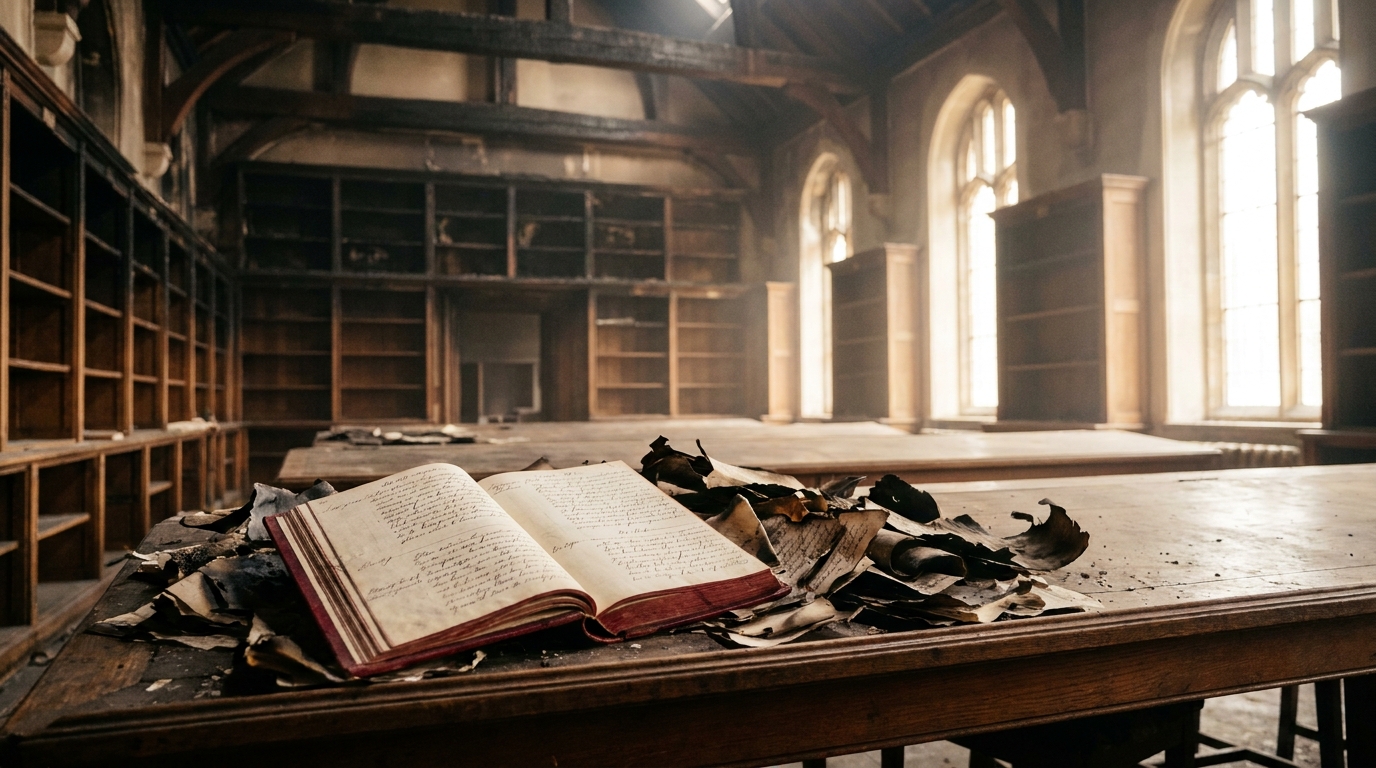
On the morning of 30 June 1922, the Public Record Office of Ireland was, by any reasonable measure, one of the best-kept archives in Europe. Wills stretching back centuries. Census returns from the 1820s, 1830s, 1840s, and 1850s. Parish registers deposited for safekeeping under an 1875 law considered good governance at the time. All of it sat inside the Four Courts complex on the north bank of the Liffey in Dublin, in a purpose-built Record Treasury designed to protect it from exactly the kind of disaster nobody thought would come.
Then anti-Treaty forces occupying the Four Courts stacked munitions inside that Treasury, the building was shelled in the opening battle of the Irish Civil War, and by afternoon it went up in an explosion so large it rained scorched paper over Dublin for days. By nightfall, the largest concentration of Irish genealogical material on earth was ash and smoke.
For a hundred years afterward, “the records all burned” has been the sentence that ends Irish family history before it starts. So let me tell you something before we go further: that sentence is wrong. Not wrong the way a rumor is wrong — wrong the way a half-true story is wrong, which is the most dangerous kind, because there’s just enough truth in it to make you swallow the rest.
Why This Matters, Even If You Don’t Have a Drop of Irish Blood
Here’s the thing nobody tells beginners: this isn’t really an Irish problem. It’s a pattern — and once you can name it, you’ll start seeing it everywhere. In the American South, where Civil War-era courthouse burnings wiped out county after county of vital and land records. In any situation where the record you wanted simply doesn’t exist anymore, for reasons that have nothing to do with your ancestor and everything to do with history’s habit of occasionally catching fire.
Ireland just happens to be the most famous, best-documented classroom for learning what to do about it. Master the method here, on a fire everybody’s heard of, and you’ll have it ready the next time a wall goes up with a different flag on it.
What Actually Burned — and the One Distinction That Explains Everything
The exaggerated version of this story treats 1922 as a single catastrophic wipe of “Irish records,” full stop. The real version is narrower, and understanding why is the whole key to this mission.
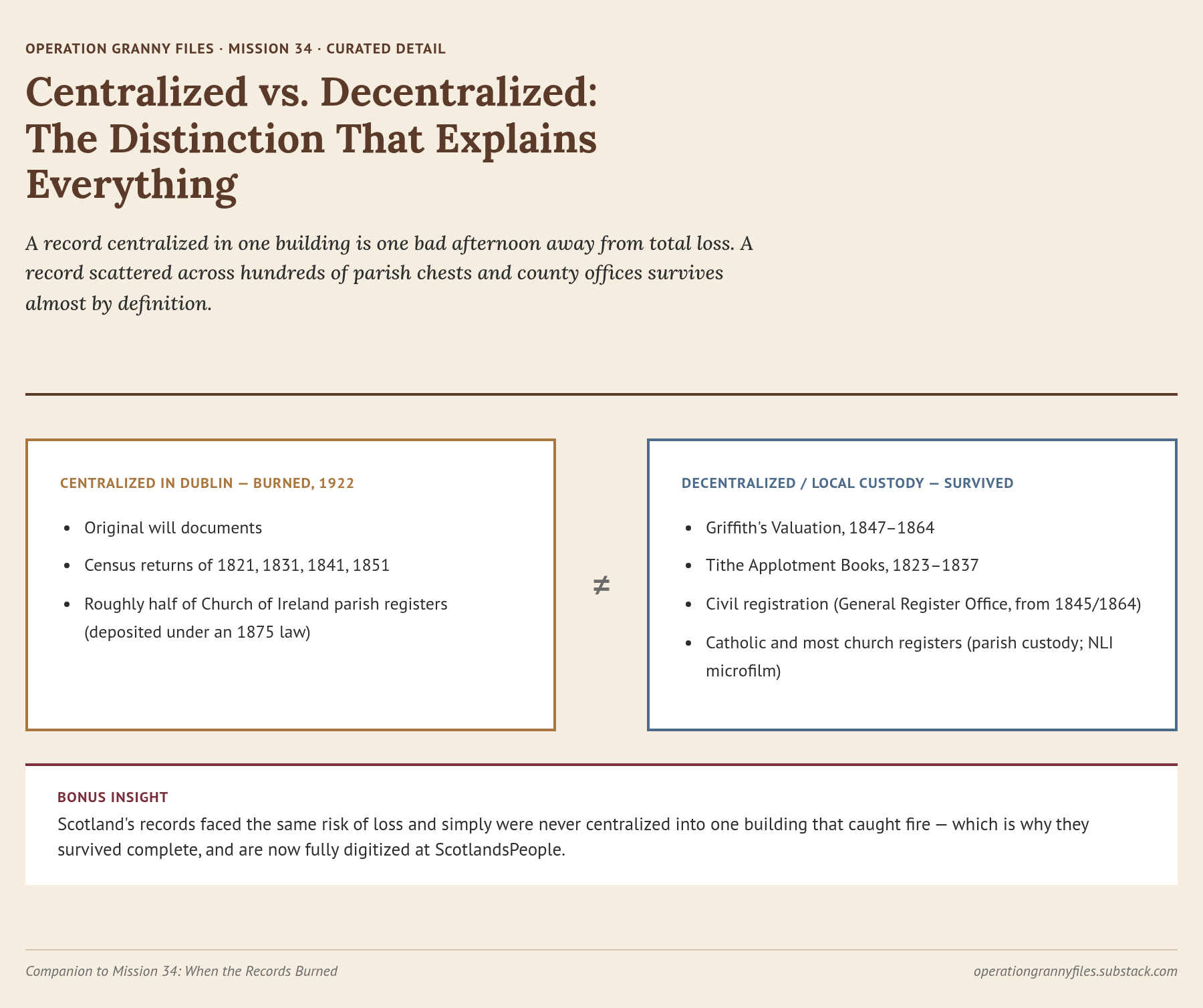
What burned was, almost entirely, material that had been centralized in Dublin: the original will documents; the four surviving pre-Famine census returns of 1821, 1831, 1841, and 1851 (the later ones, 1861 through 1891, had already been destroyed or pulped decades earlier for unrelated bureaucratic reasons — don’t blame the fire for those); and roughly half of the Church of Ireland parish registers deposited under that 1875 Act.
What survived was, almost entirely, material never sent to Dublin in the first place — records kept in decentralized custody, out in the parishes and counties and local registries where they were created.
That’s the most useful lens in this entire mission: centralized versus decentralized custody. A record centralized in one building is one bad afternoon away from total loss. A record scattered across hundreds of parish chests and county offices survives almost by definition, because no single disaster can reach all of it at once.
Once you see that, the “what survived” list stops looking like a lucky consolation prize and starts looking like exactly what you’d have predicted.
Griffith’s Valuation (1847-1864) — the countrywide property survey recording the occupier of essentially every parcel of land in Ireland — was compiled and held locally, never deposited in the Treasury, and survived intact. Because it lands squarely in the gap left by the missing census years, it’s the closest thing Ireland has to a mid-century census substitute. Free to search at Ask About Ireland.
The Tithe Applotment Books (1823-1837), an earlier land-assessment survey, survived for the identical reason — local custody — and are free to browse by county and parish at the National Archives of Ireland.
Civil registration is the real bright spot. Non-Catholic marriages from 1845, and full registration of births, marriages, and deaths from 1864 onward, were maintained by the General Register Office rather than the Treasury, and came through the fire untouched. Free to search at IrishGenealogy.ie.
Church registers, especially Catholic ones, were essentially never centralized at all. They stayed in parish custody, and the National Library of Ireland’s microfilm holdings — increasingly indexed for free through FamilySearch — cover most of the country from the early-to-mid 1800s onward.
Wills are the genuinely hard loss. The originals are gone. But the National Archives’ Calendars of Wills and Administrations, 1858-1922 survive as an index: not the will itself, but a summary carrying name, address, occupation, date of death, and executor. Often that’s enough.
Notice what that list isn’t. It isn’t “everything survived, don’t worry.” Real loss happened, and Granny won’t pretend otherwise — three generations of Irish family historians inherited a harder problem than their English or Scottish counterparts. But “harder” and “impossible” are different words, and the folklore version collapses them into one.
Watching the Method Work: One Family, Four Substitutes
Let’s put this into practice, because a checklist means nothing until you’ve watched it run.
Say your research points to a family named Doyle in rural County Wexford in the 1850s, and you discover that no census survives for that decade — 1851 was one of the four that burned. That’s where most beginners stop. Don’t.
Start with Griffith’s Valuation, compiled for Wexford in the early 1850s. You find a Patrick Doyle occupying a small holding in a named townland, with a named landlord and a valuation figure. Not a family snapshot — but a confirmed household, place, and date range, which is more than you had an hour ago.
Next, the Tithe Applotment Books, a generation earlier, for the same townland. A Doyle household appears there too, farming a similar-sized plot — plausibly the same family a generation back, though you’ll want more before calling it proven.
Now pull the Catholic parish register for that townland’s parish, indexed through FamilySearch. Baptismal entries turn up for several Doyle children across the 1840s and 1850s, naming both parents — Patrick Doyle and Bridget, maiden name Kavanagh. That’s the parent-child linkage the burned census would have handed you directly, arrived at sideways.
Finally, check the Calendar of Wills and Administrations for a Patrick Doyle of that townland. You find an administration entry from the 1870s: his death year, his last address, and the man who administered his estate — who turns out to be his son, already named in the baptismal register a step ago.
Four records, four offices, not one of them the record you originally wanted. Together they hand you a family reconstructed with more corroboration than a single census return would ever have given you. That’s substitution research. It isn’t a consolation prize for the record that burned. Done properly, it’s sturdier.
Granny Got This Wrong Once
Early in my own research, I found a single Griffith’s Valuation entry for a surname I was chasing and treated it as proof I’d found the right family — because it was the only record I had and I badly wanted it to be enough. It wasn’t. Griffith’s Valuation records occupiers, not necessarily owners, and says nothing about family relationships on its own. I’d found a plausible household in the right townland, not a confirmed ancestor, and it took me an embarrassing while to admit the difference.
Here’s the habit that would have saved me the detour. Griffith’s Valuation and the Tithe Books are excellent for place and presence — confirming a surname lived in a specific townland at a specific time. They are weak on relationship. For that you need a document naming people in connection to each other: a baptismal entry naming both parents, a will naming a daughter and her husband, a Calendar entry naming an administrator. Treat a single land-valuation hit as a lead pointing to where you look next, never as the answer. It’s a distinction every genealogist learns exactly once, usually the hard way.
Scotland: The Same Island, the Opposite Story
Now cross the water, because the contrast shows how much of Ireland’s loss was avoidable.
Scotland began compulsory civil registration on 1 January 1855 — nine years ahead of Ireland — and did it with unusual thoroughness. Scottish birth records name both parents and their marriage date and place. Marriage records name both sets of parents. Death records name the deceased’s parents and often the cause of death. Before 1855, the Old Parish Registers of the Church of Scotland survive from as early as 1553, kept parish by parish rather than gathered into one vulnerable building. And Scottish wills and testaments survive as complete, full-color digitized originals from 1513 to 1925 — essentially the class of document Ireland lost. All of it lives on one platform, ScotlandsPeople, run by the National Records of Scotland.
The Scots, bless their tidy, well-organized hearts, invented an unusually good registration system and then simply never set fire to it.
That’s not a national character trait. It’s historical accident layered on a sound administrative choice. Scotland’s central repositories were never caught in a war; Ireland’s were centralized and caught directly in one. Record survival is a product of luck and filing philosophy, not something baked into a country or a people — which is the reframe that makes the Irish story feel less like fate and more like an explainable event.
Your Substitution Checklist, Step by Step
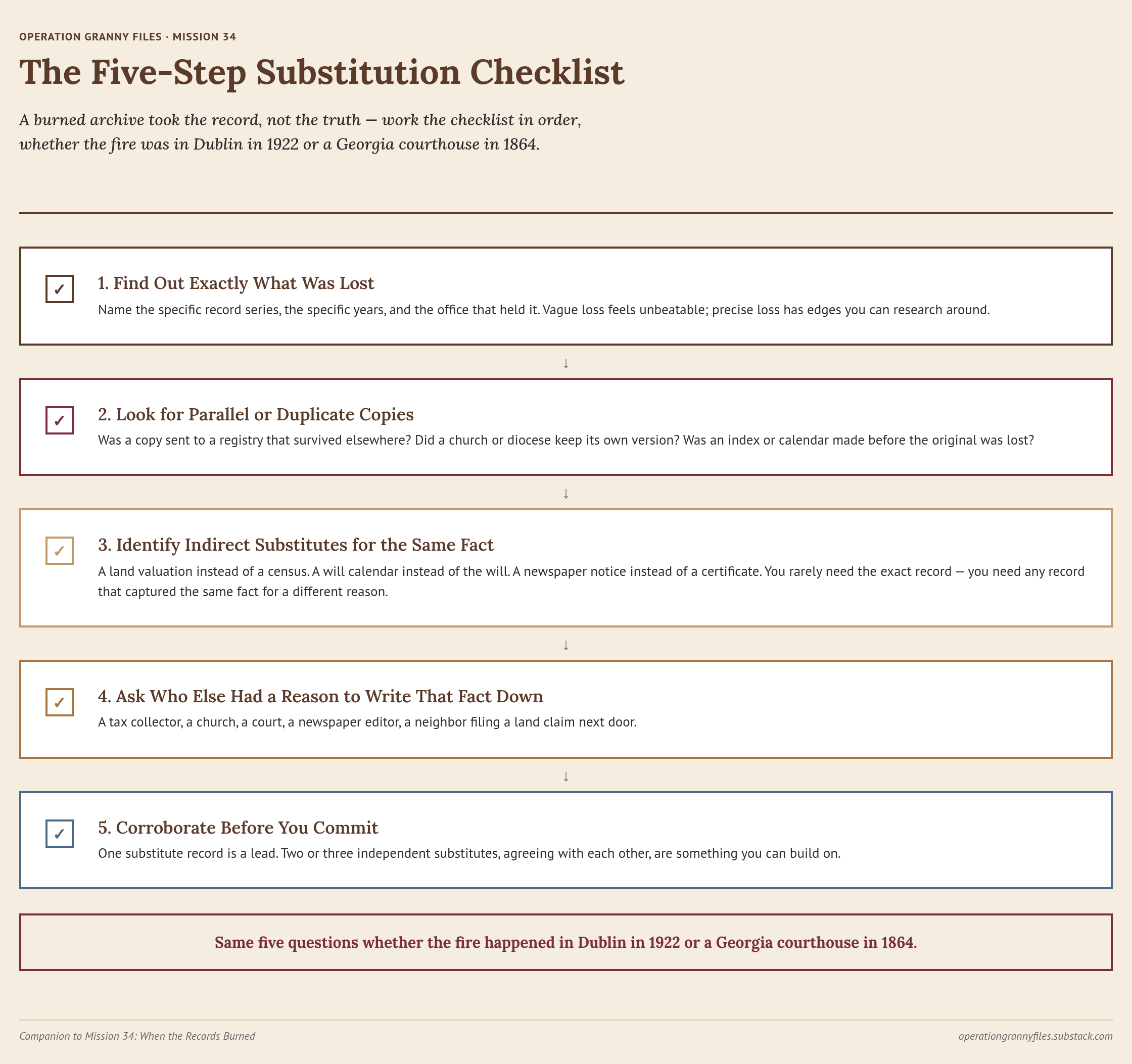
When you hit a record that’s gone — in Ireland, in a burned American county, anywhere — work through these in order.
- Find out exactly what was lost. Not “everything.” Name the specific record series, the specific years, and the office that held it. Vague loss feels unbeatable; precise loss has edges you can research around.
- Look for parallel or duplicate copies. Was a copy sent to a registry that survived elsewhere? Did a church or diocese keep its own version? Was an index or calendar made before the original was lost?
- Identify indirect substitutes for the same fact. A land valuation instead of a census. A will calendar instead of the will. A newspaper notice instead of a certificate. You rarely need the exact record — you need any record that captured the same fact for a different reason.
- Ask who else had a reason to write that fact down. A tax collector, a church, a court, a newspaper editor, a neighbor filing a land claim next door. Somebody usually needed to know the same thing your missing record would have told you.
- Corroborate before you commit. One substitute record is a lead. Two or three independent substitutes, agreeing with each other, are something you can build on.
This is exactly the discipline American researchers call “burned county” research. The term comes from the Civil War-era South, where courthouse fires — Union troops alone destroyed a dozen Georgia courthouses — wiped out vital and land records across Georgia, Alabama, Mississippi, and Virginia. The response is structurally identical: inventory the loss, inventory the survivors, and go hunting for whoever else wrote the fact down.
Where Beginners Get Stuck
A few honest pitfalls, so you recognize them instead of mistaking them for dead ends.
You’ll read “the records burned” and stop, without checking which records. As you’ve seen, that phrase describes a fraction of what people assume.
You’ll treat a single substitute as proof, the way I once did with that lone Griffith’s Valuation entry. A place-and-presence record is not a relationship record. Don’t collapse the two.
You’ll assume Ireland’s loss means nothing is left to search for free. In 2026 that’s more wrong than ever. The Virtual Record Treasury of Ireland has spent years digitally reconstructing large portions of what the Public Record Office lost, pulling in copies and duplicates from partner archives worldwide, and passed half a million freely accessible records this year. Start there, and at the National Archives of Ireland’s genealogy portal, before concluding a record is gone for good.
You’ll assume the substitution method only works for Ireland. It doesn’t. Same five questions whether the fire happened in Dublin in 1922 or a Georgia courthouse in 1864.
What’s Left When the Archive Isn’t
An archive fire is a real loss, and I won’t pretty it up. Somewhere in that Record Treasury a version of your family’s history burned, and it isn’t coming back.
But the records that survive — in a hundred scattered parish chests and land offices and courthouses — aren’t a diminished version of the story. They’re a different way into the same story, and frequently better corroborated, not worse, precisely because you had to find four sources instead of trusting one.
The most resilient family historians I know aren’t the ones lucky enough to have an intact archive behind them. They’re the ones who learned, sooner or later, to read what’s left.
GRANNY SAYS: A burned archive took the record, not the truth. Follow the substitutes, cross-check the pattern, and the story is still there for anyone willing to look sideways.
Leave a comment on the published mission.
Teaching Kids to Solve a Case With Half the Evidence Missing
There’s no better lesson in real research than a puzzle with a hole punched through the middle of it. Hand a young person an intact census and they’ll copy names off a page; hand them a family whose census burned in 1922 and they have to think like an investigator — who else would have written this down, and why? The Operation Granny Files Homeschool Workbook turns that into a solvable case: a loss-inventory worksheet, a substitution ladder running from the missing record to the ones standing in for it, and a corroboration drill that teaches the difference between a lead and a fact. It’s history, geography, and evidence reasoning in a detective’s coat. Give them the burned archive on purpose — it’s the version of the assignment that actually teaches something.
Get the Operation Granny Files Family History Adventure →
Mission Downloads
Catch Up on the Series Browse every lesson in the Operation Granny Files mission archive.