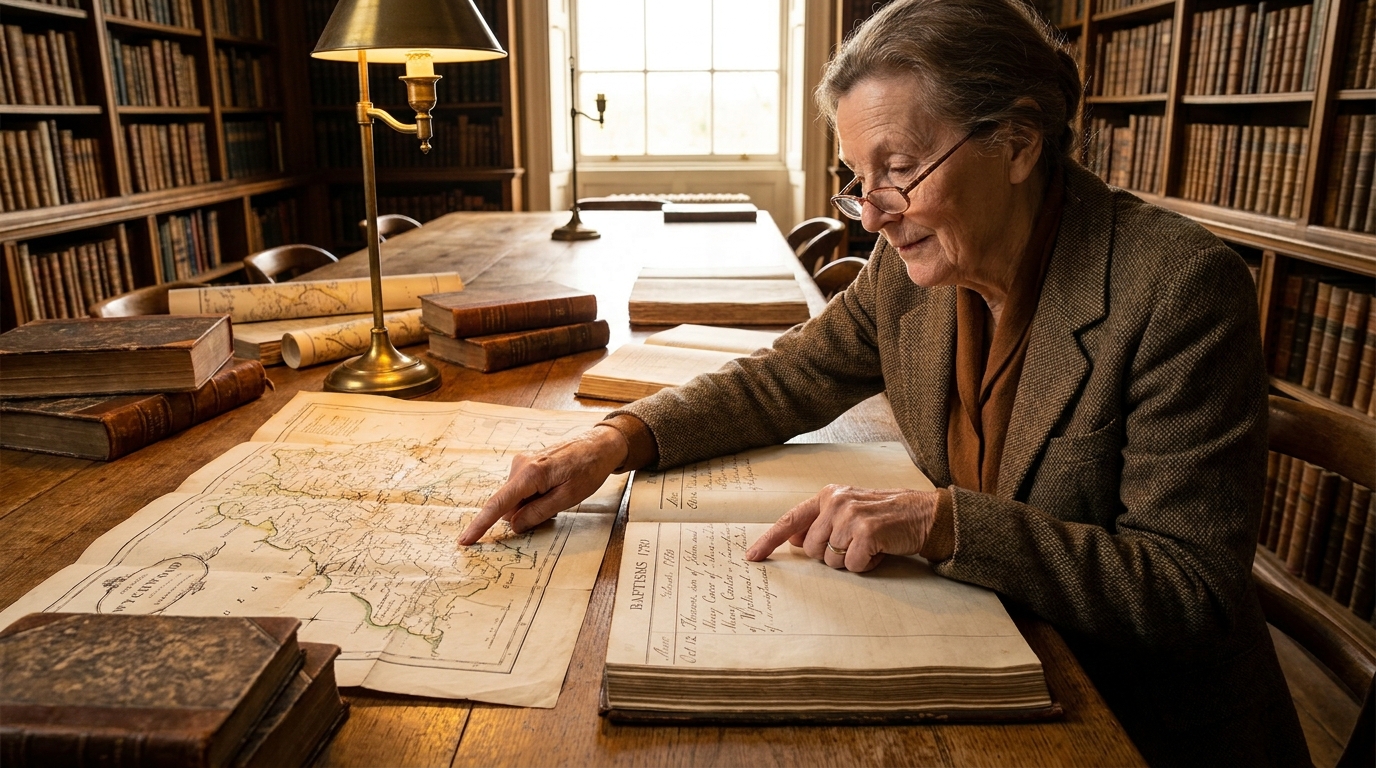
Mission 33: Crossing the Channel — England & Wales: Parishes, Counties, and the Records That Survived
Storyteller — The System That Actually Worked
English genealogy is not complicated. It’s different from American genealogy, but it’s actually more organized than what we’re used to.
I’m willing to admit I was surprised by that.
For the last thirty-odd missions, I’ve been teaching you how to work around chaos. Courthouse fires. County boundaries that moved three times in fifty years. A census bureau that changed how it counted something in the middle of a run, so the data from 1880 means something different from the data in 1890. You’ve gotten very good at chaos. You’ve learned patience. You’ve learned to treat a brick wall as a puzzle with an answer, not a dead end.
England has a different problem. England has order.
And I don’t know about you, but the moment I realized that the whole three-hundred-year chunk of my family history sat in parish registers that had survived nearly intact, with reference numbers still legible, with margins still readable, I felt something I don’t usually feel when doing genealogy research.
I felt grateful to a bureaucracy.
Why This Matters More Than It Looks Like It Does
If your family tree has a line that “just came from England” and stops there, this is the mission that unsticks it. England and Wales aren’t one more record set to learn — they’re a structure, parish inside county inside country, and once you understand that structure, it does most of the work for you. The catch is that the structure only works if you enter it in the right order. Enter wrong, and you’ll spend a weekend scrolling parish registers for a surname so common it’s meaningless. Enter right, and the same registers hand you three hundred years of your family in one sitting.
Teacher — The Parish, the Census, the Home Abroad
The Parish System: 1538 to Now
In 1538, a man named Thomas Cromwell — working as Vicar General under Henry VIII — issued an order that every parish priest in England had to keep a written record of every baptism, marriage, and burial he performed. That was not a small thing to ask. That was asking thousands of clergy across an entire country to take on bookkeeping as a sacred duty, and to do it right, legibly, durably, for centuries.
They mostly did.
That single order — issued nearly five hundred years ago — is the reason you can often trace an English ancestor back to 1550, back through three hundred years of records sitting in a parish church, often in the same building, watched over by successive generations of clergy and clerks. It makes English genealogy, despite all the unfamiliar vocabulary, fundamentally different from American genealogy — steadier.
But it wasn’t static. Two later reforms matter enough to keep straight.
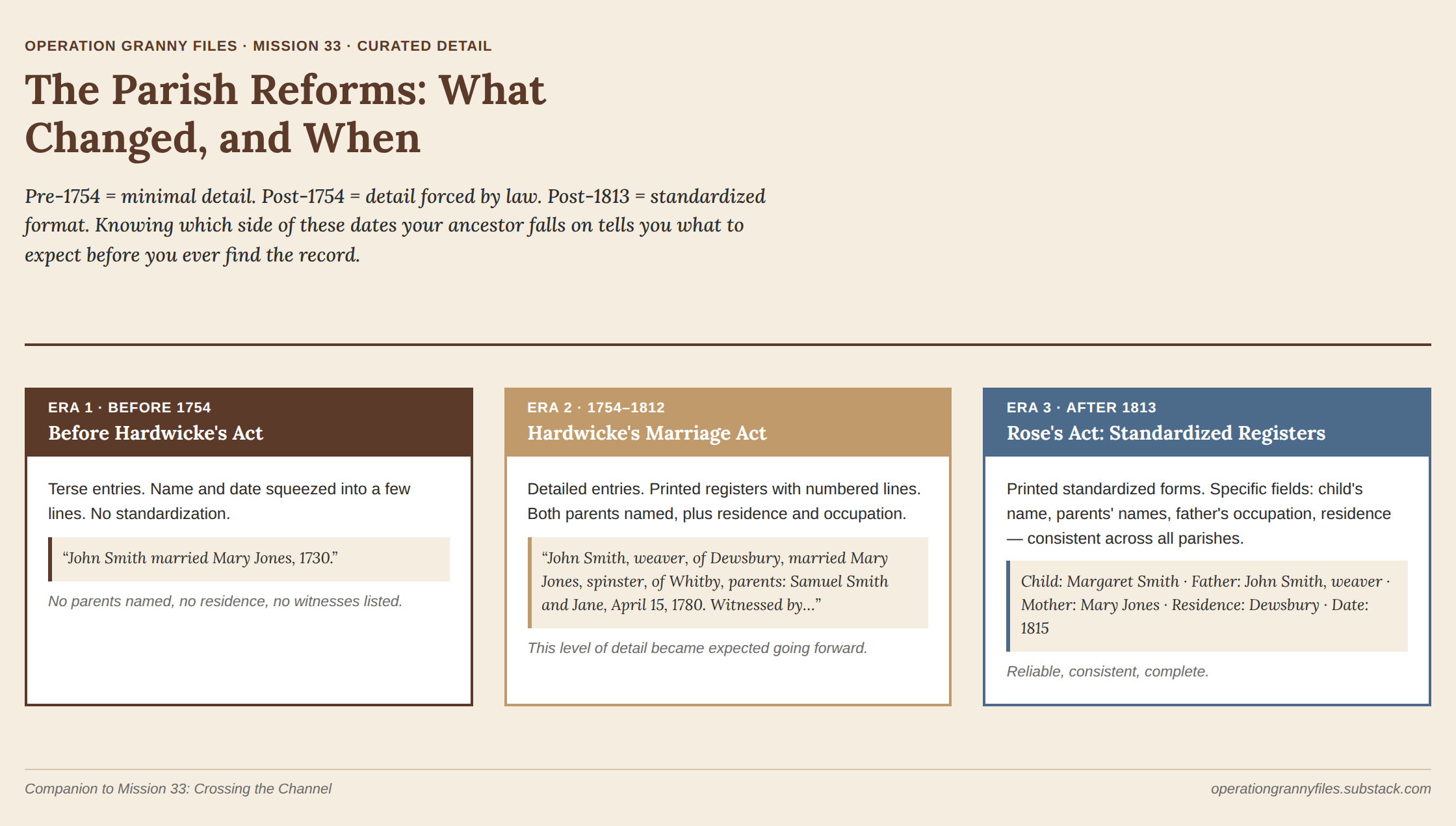
Hardwicke’s Marriage Act of 1754 closed a loophole that had let people get married almost informally — a couple could get married by any clergyman, anywhere, and it counted, legally, as a marriage. After 1754, a marriage had to happen in a licensed church, in the home parish of the bride or groom, after banns were read or a license obtained, witnessed by two people, and recorded in a dedicated printed marriage register with numbered lines and space for specific information. If you’ve ever read a pre-1754 marriage entry and found nothing but a name and a date squeezed into four lines, and then found a post-1754 entry that named both parents, the bride and groom’s residence, their occupation, who witnessed it — that’s Hardwicke’s Act at work. It forced detail into the record.
Rose’s Act of 1812 did the same for baptism and burial registers. Starting January 1, 1813, every parish had to use printed, standardized registers with specific fields: child’s name, parents’ names, the father’s occupation, the residence. The entries before 1813 can be maddeningly terse. The entries after are consistent, detailed, and — most importantly for research — they reliably tell you what you’re looking for.
Knowing which side of these two dates your ancestor falls on tells you what to expect from the record before you ever find it. That’s not luck. That’s structure.
Civil Registration and the GRO: 1837 Forward
On July 1, 1837, England and Wales stopped relying on the Church of England to track everybody’s vital events. The government created the General Register Office — the GRO — and made it law that every birth, marriage, and death had to be registered with the state, independently of who married you or what church you belonged to or whether you belonged to any church at all.
For genealogy research, this is enormous. It means that if your ancestor’s family belonged to a denomination that didn’t keep careful records, or left no records behind — the state’s civil registration has them anyway. It’s systematic. It’s searchable.
The GRO is still centralized, based in Southport, and it’s searchable from your desk. You can search the birth index (roughly 1837-1916), the marriage index (roughly 1837-present), and the death index (roughly 1837-1957) directly on the GRO’s own website, enter a name and a year, and get back a reference number.
That reference number is the most valuable thing you can capture from the index, because it collapses processing time from about 15 business days down to about 4. The GRO offers two ways to get the information: a full certified paper certificate — costlier, slower, with legal standing, needed if the document is for anything official — or, for research alone, an instantly downloadable PDF image of the actual register entry, a few pounds, holding the entry in its own handwriting or printing with all the detail the clerk put there. The rule of thumb: for research, grab the PDF. For anything official, go back and get the certified paper.
The Census: The Bridge Between Two Eras
Here’s the thing about English records: the civil-registration system (1837 forward, searchable and indexed) and the parish-register system (1538-1837, scattered across dozens of parishes and often not indexed) are geographically the same country, but methodologically they’re on different planets. It’s hard to jump from one to the other without getting stuck.
Enter the census.
England and Wales have taken a census every ten years since 1841 (with gaps for the World Wars and the destroyed 1931 census). All the censuses from 1841 through 1921 are now open to researchers, and they live in the middle — they’re the bridge. If you have a civil-registration certificate, you have a place of residence. Step back ten years in the census and look for your ancestor in that place. Find them? Excellent. Now you have an occupation, the names of the children living at home, and — critically — if it’s an 1851 census or later, you have a specific birthplace. Not just “England.” Not even just “Yorkshire.” You have “Dewsbury” or “Whitby” or “Kendal.”
That place name is the password that unlocks the parish registers.
Watch It Work: One Family, Census to Parish
Say your American-side records tell you your ancestor Margaret was “born in England” — that’s the whole story your family has passed down. You find her 1861 English census entry before she emigrated: she’s fourteen, living with her parents in a mill town, and the census gives her birthplace as “Dewsbury, Yorkshire.” Not “England.” Dewsbury.
That’s your password. You now go to the Dewsbury parish registers — not a blind England-wide search — and look for a baptism around 1847 (working back from her census age). You find it: Margaret, daughter of a named father and mother, baptized at the parish church, the entry dense with detail because it falls safely after Rose’s Act of 1813. The entry names both parents. That’s your birth family, in the same register her own father would have watched the clerk fill in.
One census entry turned an unsearchable “somewhere in England” into a nine-line parish register entry naming her parents. That’s the whole method in miniature: place name first, register second, never the other way around.
The Welsh Complication: Patronymics and What It Means for Your Research
Wales is where I learned that bureaucracies are not always simple. For most of Welsh history, ordinary people did not have fixed hereditary surnames. They had a patronymic system: your “surname” was your father’s given name, marked with “ap” or “ab” for men or “ferch” for women. Evan, son of Thomas, was Evan ap Thomas. Evan’s son John became John ab Evan. John’s son Rees became Rees ap John. The surname changed every generation — John’s children didn’t share his “surname” because his surname was his father’s name.
Eventually — slowly, unevenly, region by region — this wore down into fixed surnames. “ap Hywel” became Powell. “ap Rhys” became Price. But far more often, the patronymic form simply froze as it was, which is why Wales today has a startlingly small pool of surnames: Jones, Evans, Davies, Williams, Thomas, Roberts — nearly all of them patronyms, common enough that a single Welsh parish can hold fifteen John Jones entries in a single decade.
Granny’s confession: I once spent an afternoon convinced I’d found my Welsh great-great-grandfather in a parish register on nothing but a matching name — only to learn the parish held four other men with that exact name, born within a decade of each other. Surname alone will not sort out fifteen John Joneses. What will: lean hard on given names, on occupation, on the specific place — not just the parish, but the farm name if you can find it — and on the patronymic pattern itself. If you have John ap Evan born in 1820 and his son was named James ap John, that’s a pattern, and it confirms the right John, the right father, the right generation.
The “Find the Home Parish” Method: Before You Touch an English Record
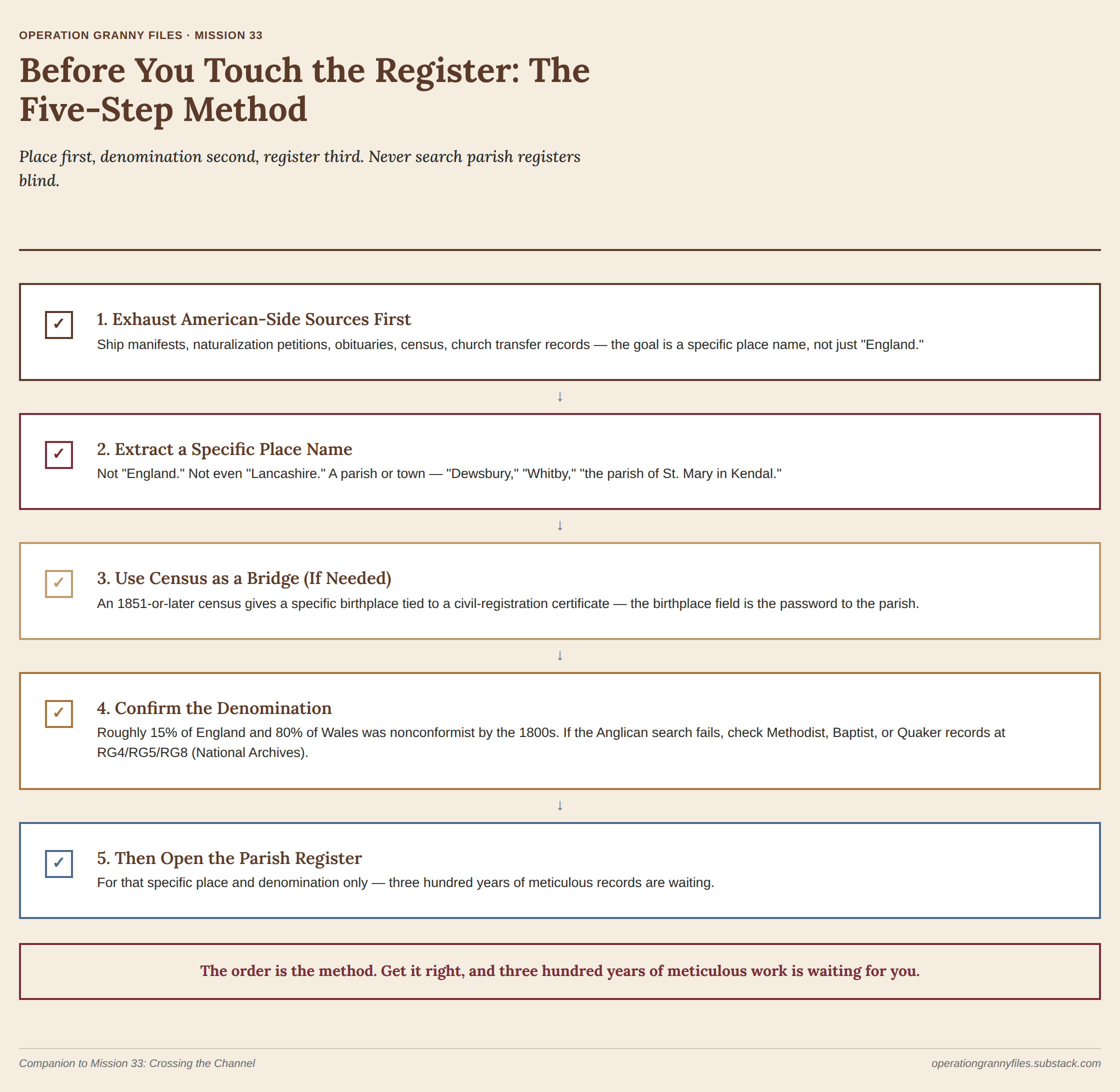
This is the method the whole mission hinges on — the move that separates beginners who get stuck from researchers who go forward. Never start by searching English parish registers blind. Work through it in order:
- Exhaust the American-side sources first. Ship manifests — especially post-1893 arrivals, which often list the passenger’s last residence and sometimes a relative left behind. Naturalization petitions, which legally required a place and date of birth. Obituaries, family bibles, passport applications, the informant’s statement on a death certificate, census records, and church membership transfer records from the sponsoring American congregation.
- Extract a specific place name from those sources — not “England,” not even “Lancashire,” but a parish or town: “Dewsbury,” “Whitby,” “the parish of St. Mary in Kendal.”
- Use the census as a bridge if you don’t have a place name yet (see the worked example above) — an 1851-or-later census gives you a specific birthplace tied to a civil-registration certificate you already hold.
- Confirm the denomination before opening any register. About 15 percent of England and up to 80 percent of Wales belonged to a nonconformist denomination — Methodist, Baptist, Quaker, Catholic — by the late 1800s, and their baptisms and burials may not be in the parish registers at all. Those records sit at The National Archives under series RG4, RG5, RG8, and are now available on Findmypast.
- Only then open the parish or nonconformist register for that specific place and denomination.
That order — place first, denomination second, register third — is what separates the researchers who find their people from the ones who give up.
Where Beginners Get Stuck
You’ll search “England” instead of a parish. A name search with no place attached, run against three hundred years of parish registers, returns either nothing or everything — neither is useful. Get the place first.
You’ll assume Anglican when your ancestor wasn’t. If the parish register has no matching baptism where the census says there should be one, don’t conclude the record was lost — check whether the family was nonconformist before you give up on the parish route entirely.
You’ll pay for a certified certificate you didn’t need. The GRO’s certified paper certificates are for legal use. For research, the downloadable PDF is cheaper, faster, and shows you the same handwriting.
You’ll pick the wrong John Jones. In Wales especially, a single matching name proves nothing on its own — see Granny’s confession above. Confirm with place, occupation, and patronymic pattern before you attach a record to your tree.
Confidant — The Gift of Meticulous Work
You know what I keep thinking about?
I keep thinking about some clerk in 1647 sitting down with a quill pen and a leather-bound book, in a parish church in Yorkshire, and writing down the name of a baptized child because it was his job to write it down. He did not know he was doing it for a stranger three hundred and seventy years later. He was just doing his job. Faithfully, carefully, legibly, knowing his handwriting had to last, had to be readable, had to survive.
That’s the same impulse that drives you to file the copies of your research notes, to label the photo with the date and the name of the person in it, to write down where a document came from so you remember it next year. It’s an act of love toward a future person — a great-grandchild, a niece, a stranger who shares the family name — who will come looking.
The reason English records survived so well, so completely, so clearly, is that ordinary people — clergy, clerks, registrars — did that small, unglamorous, faithful work for centuries. They wrote clearly. They filed carefully. They assumed their work mattered even when nobody was watching.
That’s the bureaucracy I’m grateful to. And that’s the spirit your ancestor brought to the marriage register, three hundred years ago, when they made sure the clerk got the name right. They didn’t know you were coming. They just knew it mattered.
GRANNY SAYS: Find the parish before you touch the register. The order is the method — get it right, and three hundred years of meticulous work is waiting for you.
Teaching the Generations Where “England” Really Means
The Operation Granny Files Homeschool Workbook turns the “find the home parish” method into a real research trail a young genealogist can walk: a census record, a place name, a parish register, and three hundred years of family waiting on the other side.
Mission Downloads
Catch Up on the Series Browse all missions on the Operation Granny Files Home Page or see the full list in the Archive.