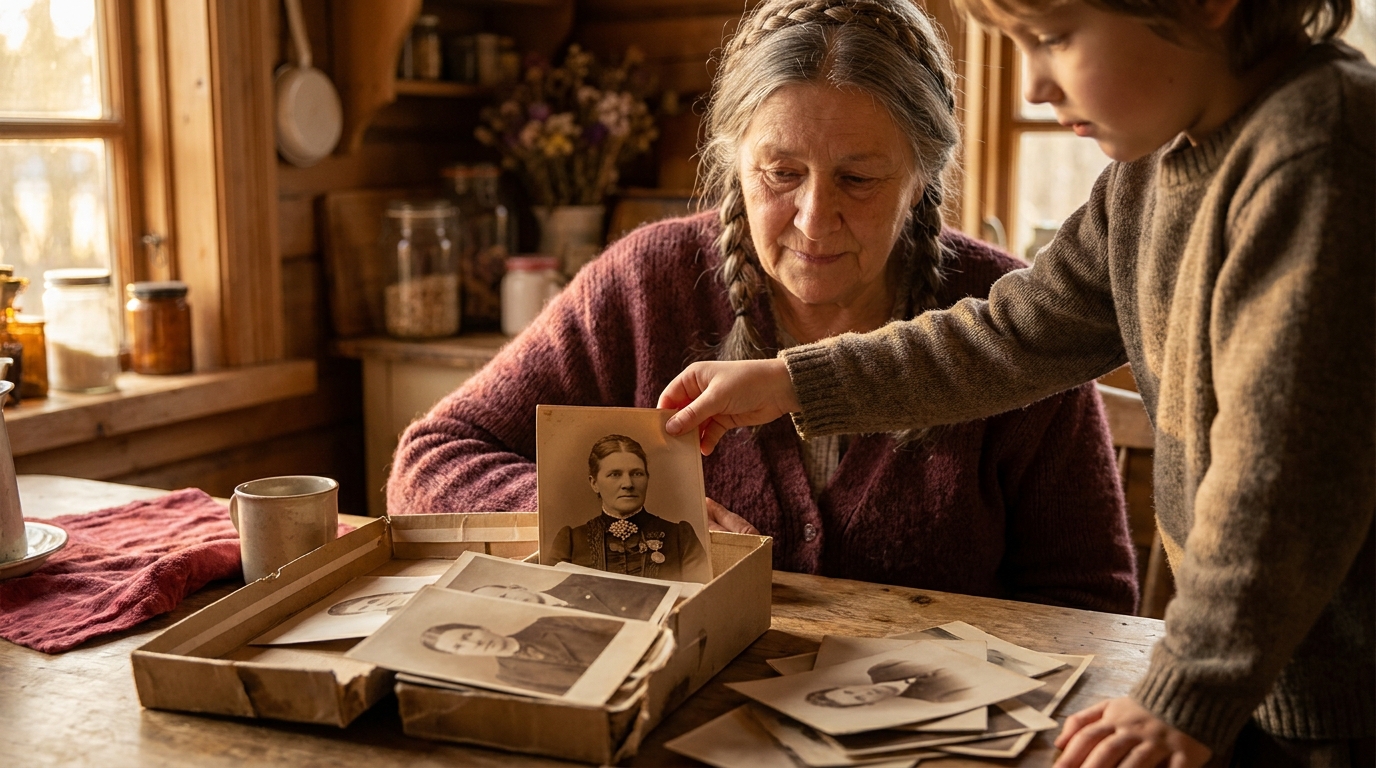
Mission 36: Bringing a Kid Into the Work
You don’t teach a kid genealogy by handing them a family tree. You teach a kid genealogy by letting them find something.
Maybe it’s a great-grandfather’s name on a gravestone, half-sunk in the grass, that nobody in three generations has bothered to read out loud. Maybe it’s Grandma telling a story nobody else in the family remembers — the one about the flood, or the runaway mule, or the summer everyone got the mumps at once. Maybe it’s an old photograph of a stern man in a hat that nobody can name, and the kid gets to be the one who cracks the case.
That’s where the curiosity comes from. Not the chart. Never the chart.
Let me confess something up front, because I think it’ll save you some grief: I was a bored kid too. A great-aunt of mine — armed with a folder of photocopies and considerably more patience than the situation earned her — sat me down in front of a pedigree chart when I was about nine and asked me to fill in names and dates for people I had never met and could not picture. I lasted four minutes. I remember nothing from that chart except the particular flavor of restlessness that comes from being told a thing is important when it feels like homework nobody assigned. It took me another twenty years to find my way back in, and when I finally did, it wasn’t a chart that did it. It was a photograph nobody could identify, sitting on top of a very ordinary, very battered biscuit tin — the same kind of tin Mission 3 taught you to sort.
Why This Matters More Than It Feels Like It Should
Here are the stakes, plainly. If the only genealogy a kid ever meets is a blank chart and a request to fill it in, most kids will meet genealogy exactly once and never come back. That’s not a character flaw in the kid. It’s a design flaw in the on-ramp.
And it matters well beyond your own living room. Every family historian eventually becomes the last one standing who remembers why any of this mattered, and the only real insurance policy against that is a kid, somewhere in the next generation, who caught the bug early enough to keep the thread going. Get the handoff right once and you haven’t just filled an afternoon. You’ve built the next person who does this work after you.
The Chart Is the Problem
Here’s the thing nobody tells you when you’re staring at a bored ten-year-old across the kitchen table: a name on a chart is inert. It just sits there. It asks the kid to memorize a fact about a stranger, and strangers are, by definition, not interesting.
A name on a gravestone the kid found themselves, a story only Grandma remembers, a photograph the kid gets to solve — those are active. The kid isn’t being told information. The kid is discovering it. That single shift, from chart-filling to detective work, is the whole trick. Everything else in this mission is just working out how to pitch it at the right altitude for the kid in front of you.
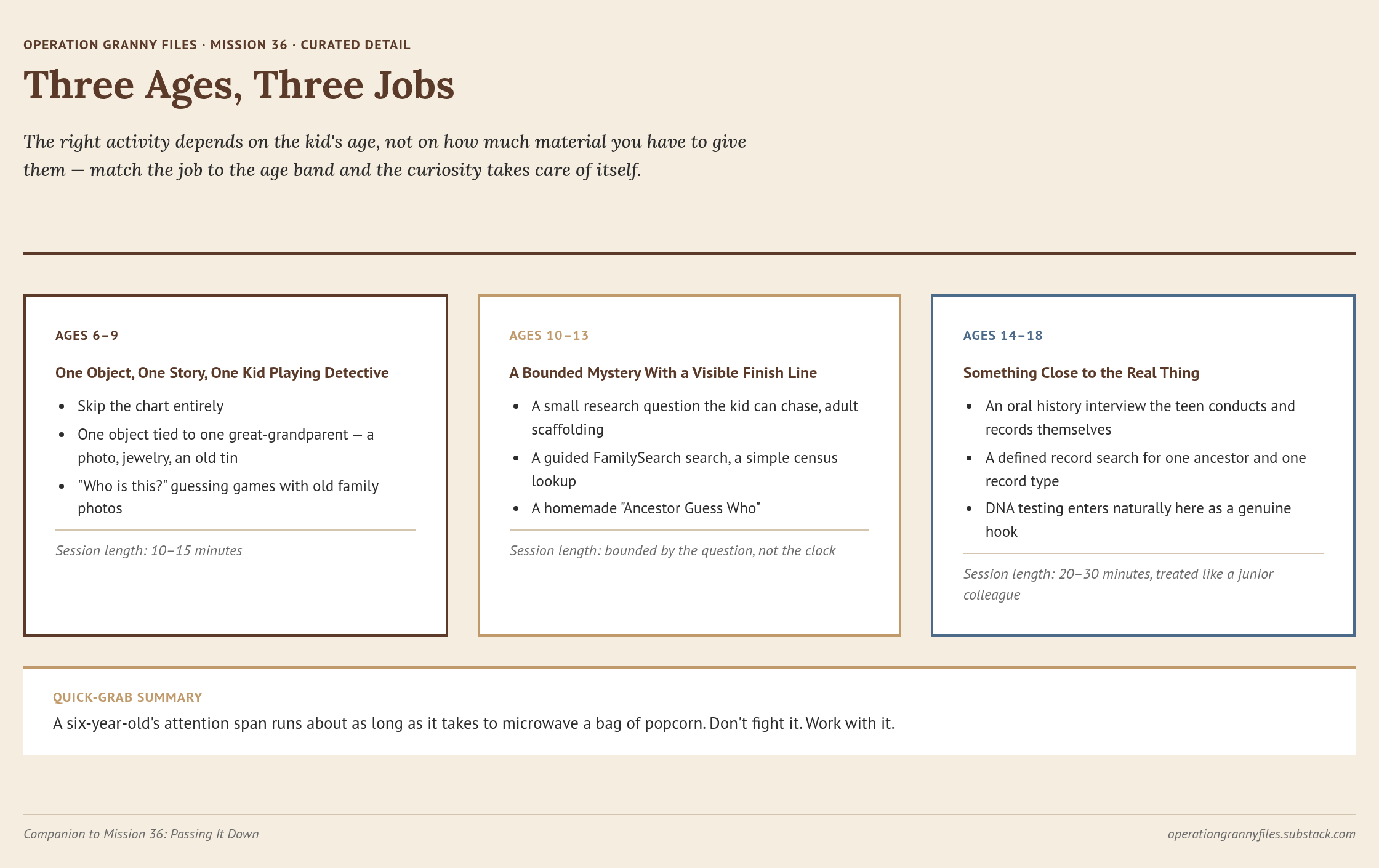
And the right altitude really does depend on how old that kid is. Not because younger children are less capable, but because their brains are built to hold attention on different things for different lengths of time, and fighting that is a losing move. A six-year-old’s attention span runs about as long as it takes to microwave a bag of popcorn. Don’t fight it. Work with it.
Ages 6 to 9: one object, one story, one kid playing detective. This is not tree-building age. Skip the chart entirely. Pick a single great-grandparent, hand the child one object tied to that person — a photo, a piece of jewelry, an old tin, a genuinely ancient rotary phone if you’ve got one gathering dust somewhere — and let the story live inside the object. “Who is this?” guessing games with a stack of old family photos work beautifully at this age. So does letting a kid physically handle something strange and old and asking them to guess what it was for. Ten to fifteen minutes is a full, successful session. If you’re still going at twenty, you’ve out-lasted the kid’s actual interest and you’re now performing enthusiasm at each other.
Ages 10 to 13: a bounded mystery with a visible finish line. This is the age where a kid can hold a small research question and chase it, with you narrating and scaffolding rather than doing it for them. The key word is bounded. Not “research your family” — that’s a shapeless assignment, and shapeless assignments are where interest goes to die. Instead: “Find out what year Great-Great-Grandpa arrived at the port, and see whether the ship’s name turns up anywhere.” A guided FamilySearch search with an adult narrating what’s on screen, a simple census lookup, a homemade “Ancestor Guess Who” built out of family photos — all of it works because it has a beginning, a middle, and an end the kid can see coming.
Ages 14 to 18: something close to the real thing. Teenagers can genuinely run a small piece of actual research — an oral history interview they conduct and record themselves (the Mission 2 prompts work just as well in a teenager’s hands), a defined record search for one ancestor and one record type, a transcription project of the kind Scouting’s Genealogy merit badge and 4-H’s genealogy program are both built around. This is also the age where DNA testing enters naturally, not as a gimmick but because curiosity about ethnicity estimates and DNA matches is a genuinely age-appropriate hook into how genetic evidence corroborates — or complicates — a paper trail. Give a teenager real scope and a real deadline, and treat them like a junior colleague rather than a student being tested.
Watch It Work: The Photo Nobody Could Place
Theory is only half of this, so let me walk you through how it actually plays out.
Say you’re sitting with your ten-year-old grandson, Eli, and you pull out a shoebox of unlabeled photographs — the kind every family has, inherited from someone who meant to write names on the back and never got around to it. Instead of sorting them yourself and narrating the results, you hand Eli the box and one question: “Find me the person who shows up in the most pictures, and figure out who she is.”
Eli starts sorting. He notices a woman in a high-collared dress who appears in four different photos — sometimes younger, sometimes older, always wearing the same distinctive brooch. That’s his first clue, and he found it himself. Nobody told him to look for a repeated pin. Now the mystery has a shape: who is she?
You don’t hand him the answer. You hand him the next tool. “Let’s ask Grandma Doris — she might remember that brooch.” Eli conducts a two-minute conversation, asks his question, and then — this is the part that takes practice — he waits instead of jumping to the next one. Grandma Doris thinks for a moment and says the brooch belonged to her own grandmother, Louisa, who wore it in every photograph taken after her wedding because her late mother had given it to her.
Eli didn’t just get a name. He got a reason the brooch mattered, which is the part he’ll still remember six months from now.
Then you take it one step further. You pull up a census record together, and Eli spots Louisa’s name on the page himself, matching what Grandma Doris told him an hour ago. That’s the moment the detective work pays off — not because Eli learned a fact, but because he found one, cross-checked it, and watched it hold up. Ten minutes of that will outlast a dozen chart-filling sessions.
Granny’s confession: I tried the chart-first approach exactly once with my own grandnephew, years after I should have known better, because I assumed a tidy document would land better than a shoebox of loose photos. It did not. He filled in three boxes, asked if he could go outside, and I don’t blame him one bit. I’d forgotten my own lesson. Kids don’t want tidy. They want a mystery. Hand a kid an actual mess to sort through and you’ll get further in ten minutes than an hour of clean rows and blank lines will ever manage.
Passing It Down, Step by Step
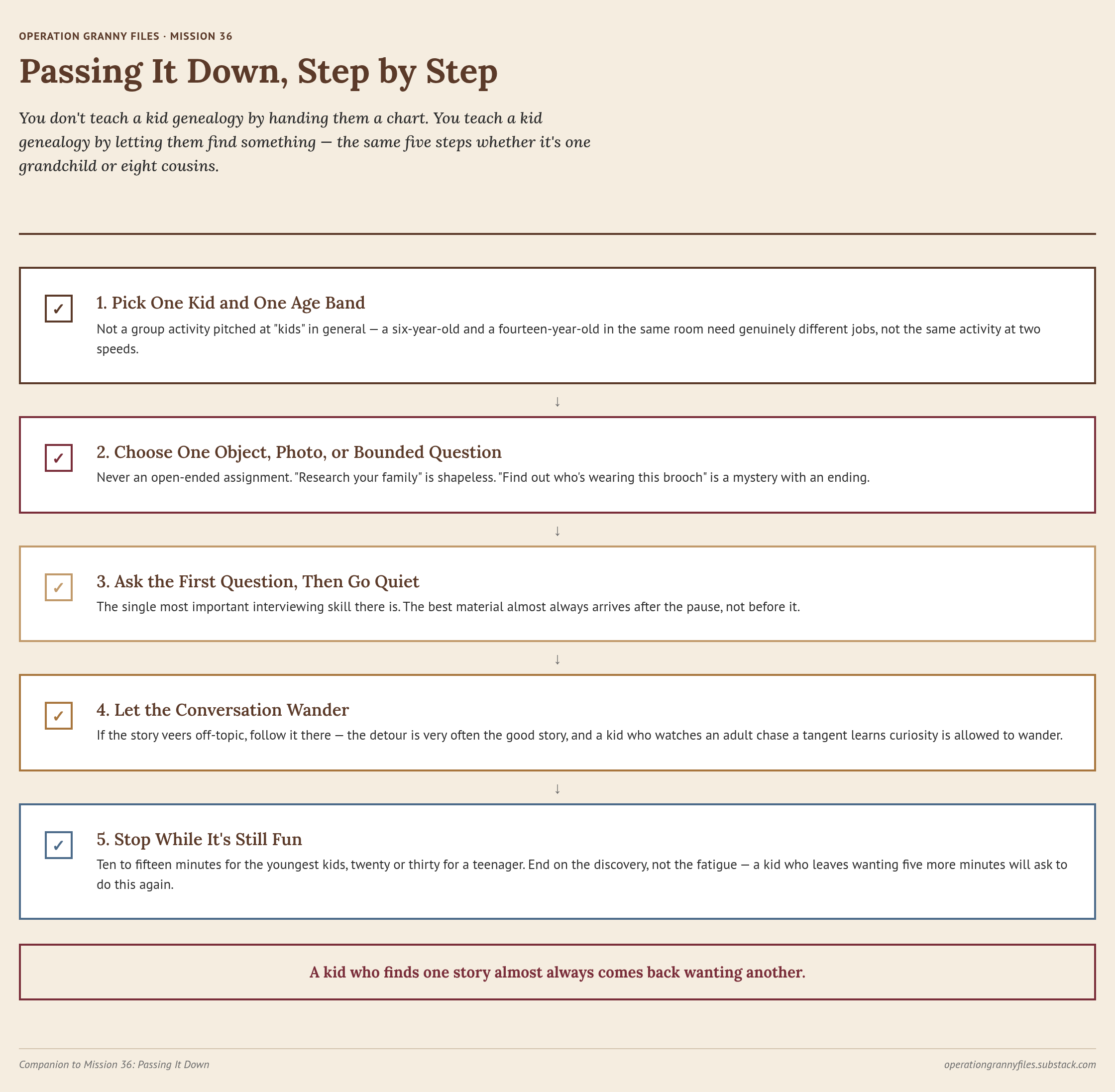
However you’re running this — one grandchild at your kitchen table, or a whole cluster of cousins at a family reunion — the same sequence works.
- Pick one kid and one age band, not a group activity pitched at “kids” in general. A six-year-old and a fourteen-year-old in the same room need genuinely different jobs, not the same activity at two speeds.
- Choose one object, one photo, or one bounded question — never an open-ended assignment. “Research your family” is a shapeless task. “Find out who’s wearing this brooch” is a mystery with an ending.
- Ask the first question, then go quiet. This is the single most important interviewing skill there is, and it applies whether the kid is talking to a relative or puzzling something out alone. Adults instinctively fill silence by rushing to the next question. Don’t. The best material — the story, the detail, the thing nobody else remembers — almost always arrives after the pause, not before it.
- Let the conversation wander. If Grandma Doris veers into the flood of 1962 instead of answering the brooch question, follow her there. The detour is very often the good story, and a kid who watches an adult chase a tangent learns that curiosity is allowed to wander.
- Stop while it’s still fun. Ten to fifteen minutes for the youngest kids, twenty or thirty for a teenager running something closer to real research. End on the discovery, not on the fatigue. A kid who leaves the table wanting five more minutes is a kid who’ll ask to do this again.
If you’re running this for a group — a homeschool co-op, a church youth activity, a family reunion with eight cousins and nowhere near enough attention span to go around — the advice compresses to one line. Break into clusters of three or four kids per adult, give each cluster one bounded task with a visible outcome, and keep the framing playful: a scavenger hunt, a mystery, a game. The moment it starts to feel like a classroom assignment, you’ve lost the room.
Where This Goes Sideways
A few honest pitfalls, because knowing them in advance keeps you from mistaking a normal stumble for proof the whole idea doesn’t work.
You’ll be tempted to correct the kid mid-discovery. Don’t. If Eli guesses wrong about the brooch before Grandma Doris sets him straight, let the wrong guess stand a minute. Being wrong first is part of what makes being right feel earned.
You’ll be tempted to cover too much ground in one sitting. One object, one story, one session. The instinct to “get through” three generations while you’ve got a captive audience is precisely how you lose the audience.
You’ll assume a chart is more efficient than an object, because it fits more information on a page. It is more efficient at collecting data. It is far less efficient at creating a kid who wants to come back next week.
You’ll hand a teenager the same simplified activity you’d give a nine-year-old, because it’s easier to prep one thing for everyone. Teens can tell when they’ve been seated at the kids’ table, and they will disengage exactly the way you would.
And you’ll forget the etiquette that keeps this feeling like family rather than fieldwork. If a cemetery visit or a recorded interview involves relatives outside your immediate household, get their comfortable consent first — and if a gravestone is old or fragile, look, don’t touch.
Give Them the Story
Here’s the part that isn’t really about genealogy at all.
What you’re handing a kid, underneath the photo-detective games and the bounded mysteries and the ten-minute attention spans, is the sense that they belong to something that started long before they showed up. That’s a bigger gift than any chart could carry, and it’s one most kids are hungrier for than they’d ever admit out loud.
The kid who finds one story almost always comes back wanting another. Your only real job is to have the next one ready.
GRANNY SAYS: You’re not handing a kid a research project. You’re handing them a mystery, and letting them find out they belong to it.
When One Story Isn’t Enough
Every method in this mission ends the same way: a kid who wants another one. That’s a wonderful problem, and it’s the exact problem the Operation Granny Files homeschool workbook, Family History Adventures, was built to solve. It takes the shoebox afternoon and gives it a second week, and a third — hands-on units a kid can work through at the kitchen table, plus a free online companion — instead of ending when the photos go back in the box. If Eli is still asking about Louisa’s brooch a month from now, don’t scramble for a new activity. Visit the Homeschool Hub and let him keep going.
Mission Downloads
Catch Up on the Series Browse every lesson in the Operation Granny Files mission archive.