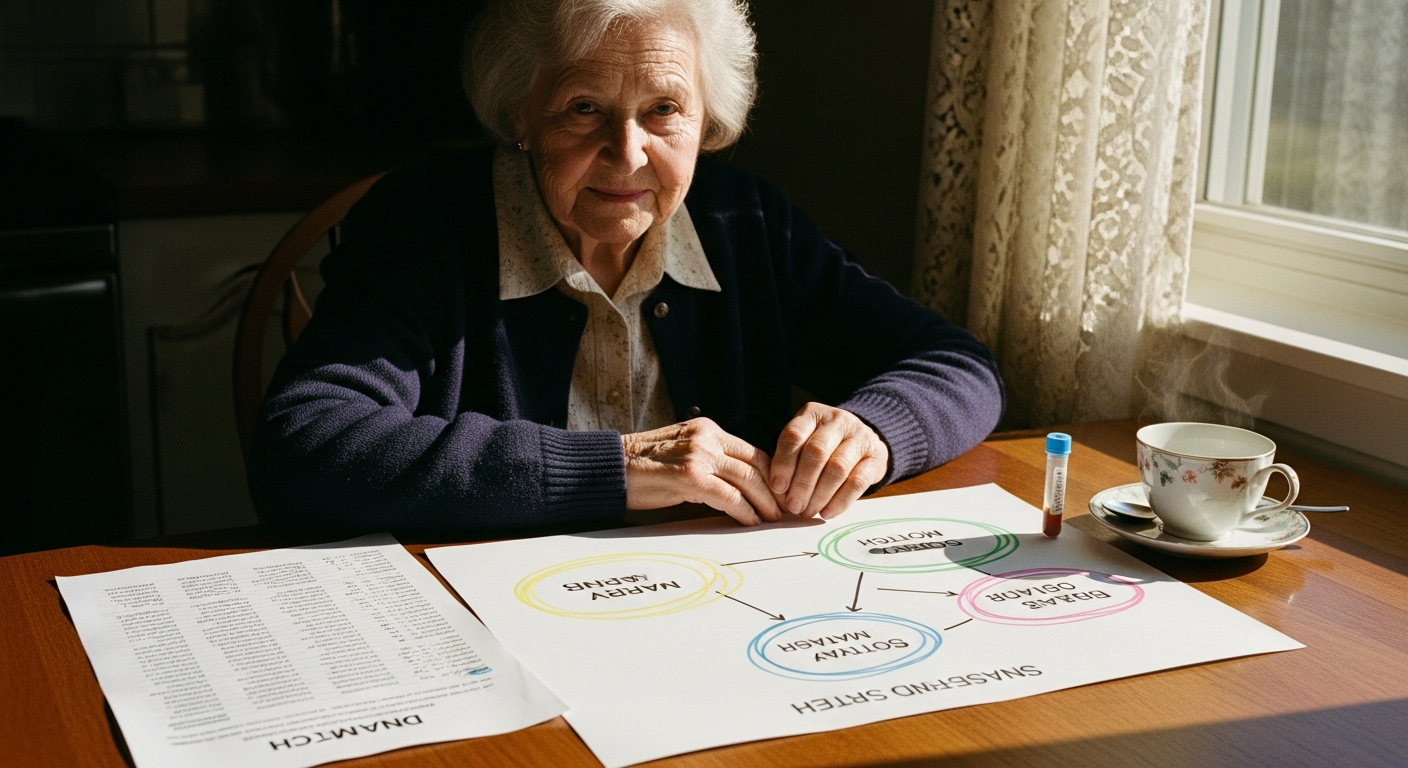
Mission 23: Advanced DNA — What Your Match List Is Actually Telling You
Beyond the Ethnicity Estimate
You are sitting at your kitchen table, again, looking at AncestryDNA on your laptop. You have dragged one cousin into a colored group—second cousin, you know her from the reunion, she’s on your mother’s side. You drag in a second match. A third. A fourth. Then you stop, because all four share DNA with each other, and you realize you are looking at something.
“That’s not magic. That’s just genetics being orderly for once,” Granny says, leaning over your shoulder. “Those four people descend from your maternal grandmother’s family. The DNA just told you in thirty seconds what would have taken ten hours to figure out from paper records. We are going to use that, dear.”
Why Your Match List Looks Like a Disaster
If you are like the median AncestryDNA user, your match list contains thousands of people, and most are useless until you sort them. The match list is not a list of cousins to send Christmas cards. It is a sorting problem you must solve before those people become useful research contacts.
Here is how the centimorgan math works, without the marketing copy:
- Matches below 20 cM are usually too distant to confirm without paper records. The segment may come from a sixth cousin, or it may be statistical noise. Interesting, but rarely actionable alone.
- Matches between 20 and 50 cM are working material. They are likely real but often need context. This is the territory where clustering earns its keep.
- Matches above 50 cM are the gold band. They are close enough to be confidently real cousins and often close enough to place using existing trees.
Before contacting anyone, sort. Sorting turns chaos into research. Pour the tea.
Shared-Match Clustering
The most powerful tool many casual researchers already have—and never use—is AncestryDNA’s Shared Matches feature. Open a match and view everyone who shares DNA with both of you. It sounds dull until you do it three times.
- Pick a close match whose branch you already know, such as a confirmed second cousin from your maternal grandmother’s side.
- Open the shared-match list and color-group everyone there. Label the group “maternal grandmother’s family.”
- Choose a known match from another branch, perhaps your paternal grandfather’s side, and repeat with another color.
- Do this for each great-grandparent line you can identify.
After several passes, closer matches begin sorting into four to eight groups, each corresponding to a branch of your tree. A list that looked like thousands of strangers becomes a family map.
People who fit no known group are either too distant to sort—or about to teach you something. A 78-cM match who shares with nobody you recognize is a brick wall waiting to be broken. Those are the matches that earn an email.
The Leeds Method
Dana Leeds formalized this clustering approach for matches in the second- to third-cousin range, usually about 400 cM down to 90 cM. The output is a color map showing which great-grandparent line a mystery match belongs to before you know their exact relationship.
- Open a spreadsheet. Add one row for each match in the target range, sorted by shared cM.
- Highlight the highest match in Color 1, then use their shared-match list to color everyone connected to them the same way.
- Move to the highest uncolored match. Mark that person and their shared matches with Color 2.
- Continue until every match is assigned to a color cluster.
Most researchers end with roughly four groups representing the four great-grandparent lines. For unknown-parentage work, this turns an enormous haystack into a four-quadrant map. For a brick wall, it tells you whether a mystery match even belongs to the branch you are studying.
Chromosome Mapping — When You Need It
Chromosome mapping is the level above clustering, and not every researcher needs it. If shared matches and Leeds have sorted your match list and narrowed your question to one branch, you may never need a chromosome browser.
AncestryDNA does not provide one. For chromosome work, use a service such as MyHeritage, FamilyTreeDNA, 23andMe, Living DNA, or GEDmatch. You can download your raw DNA file from Ancestry and upload it to a compatible service.
Each DNA segment came from a particular ancestor. If two matches share a segment on the same chromosome at the same location, they may descend from the same common ancestor. Confirming that connection lets you “paint” chromosome segments with ancestor labels.
Granny’s rule: clustering and Leeds solve 80% of the problem. Chromosome mapping closes the remaining hard cases.
A Note for Endogamous Communities
Endogamy occurs when a community has intermarried for generations, causing members to share more DNA than a single relationship would predict. This affects Ashkenazi Jewish researchers, LDS pioneer-stock families, Mennonite and Amish descendants, Acadian and Cajun researchers, small-island populations, and some deeply rooted African American communities.
The symptom is a shared-cM amount suggesting close cousinship between people who are actually fifth or sixth cousins. Standard benchmark tables can mislead you.
Adjust by clustering on the longest shared segment, not total cM. Chromosome mapping becomes more useful. Leeds still works, but color groups may overlap because several great-grandparent lines share more distant ancestors. The method still works; hold the cM numbers more loosely.
Your Mission
Download the DNA Analysis Toolkit. Use the shared-match clustering worksheet to group your strongest matches, then use the Match List Decoder to decide which mystery match deserves deeper research.
Once you know which great-grandparent line a match belongs to, you have a research lead. Once you place a name and story onto a person whose DNA arrived in your kitchen, you have something worth writing down.
Granny says: “Your match list was not broken, dear. It was unsorted. Every name is a real person at a very large, very disorganized family reunion. Clustering puts on the name tags. Leeds groups the tables. The chromosome browser settles the arguments. Once you see the groups, you can see the questions.”
Further Reading
- Blaine T. Bettinger, The Family Tree Guide to DNA Testing and Genetic Genealogy, 2nd edition.
- Blaine T. Bettinger and Angie Bush, Genetic Genealogy in Practice.
- The Leeds Method, Dana Leeds.
- DNA Painter Shared cM Tool.