Mission 24: Writing Your Family History — From Research to Narrative
Because Your Ancestors Deserve More Than a Database Entry
Read this paragraph carefully:
John Smith (1820–1890) was the son of William Smith. He married Mary Jones in 1842. They had eight children: Sarah, Thomas, William Jr., Henry, Margaret, James, Lucinda, and baby Edward (died in infancy).
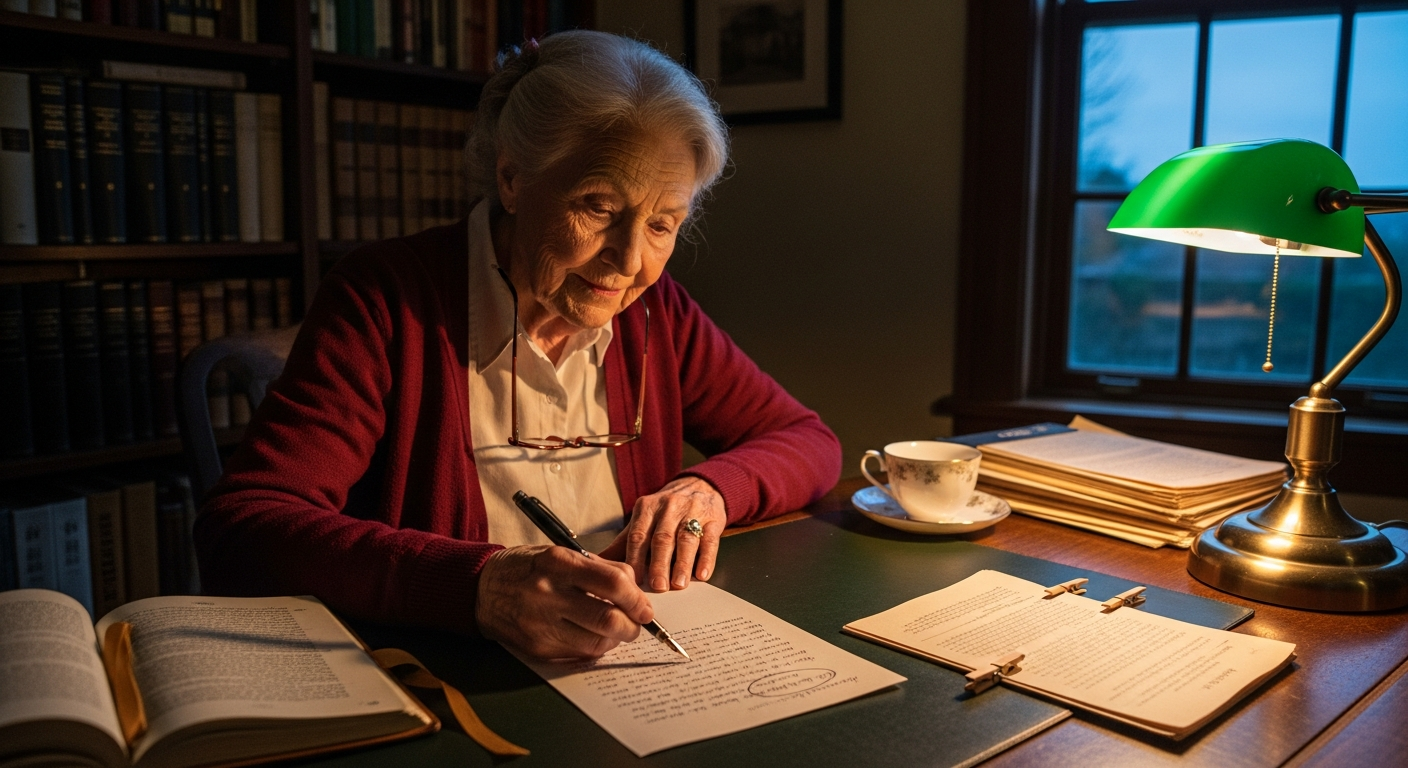
Granny sets the page down. “That is not a life, dear. That is a tax form. Today we fix it.”
By the end of this mission, you will know how to take a stack of census records, a will, and a Freedmen’s Bureau register and turn them into a paragraph someone might actually want to read. You will understand why the paragraph above fails, what a working family-history chapter looks like, and where to put it once it is done.
Pour the tea. This is craft talk now.
Why Genealogical Writing Fails
Three failure modes account for most family histories that get started, abandoned, and emailed to nobody.
1. The data dump. Names, dates, and places stacked end to end without breath. The reader has no way in. The information may be correct, but the prose is dead.
2. The wishful-thinking historical novel. The researcher invents inner monologue, dialogue, or feelings without evidence: “Mary stood at the window watching the snow fall, her heart heavy with worry…” Fiction contaminates the family record. Once you invent one detail, readers must suspect all the others.
3. The disclaimer cascade. Careful researchers write paragraphs made mostly of hedges: “She may have been born in Pennsylvania around 1818. It is possible her father was Thomas…” Precision is a virtue, but when the reader cannot distinguish what is known from what is guessed, they give up.
The fix is the same for all three: craft, not more research. The same sources that produce a dead paragraph can produce one that breathes. The difference is how you handle them.
From Sources to Sentences
How do you cite a will, census, and Freedmen’s Bureau register without breaking the narrative every three lines?
Granny’s principle: the source belongs in the footnote, the fact belongs in the sentence, and the meaning belongs in the paragraph.
The footnote layer is where proof lives: a complete, verifiable citation available to any reader who doubts the claim.
The sentence layer is where the fact lives: “By the summer of 1860, John and Mary Smith had been in Spotsylvania County for fifteen years and had filled a house with eight children.” The source supports the sentence; it does not interrupt it.
The paragraph layer is where meaning lives. Several sources—census, church record, will—work together to show not only who lived in the household, but what they built and what their circumstances meant.
Granny’s test: if you can read the paragraph aloud without stumbling on a citation, you integrated the sources correctly.
What a Chapter Looks Like
A family-history chapter can use a simple four-part structure at almost any length.
1. The hook. Begin with a documented moment—a courthouse afternoon, the day a baby was buried, the morning of a marriage—that places the reader in the ancestor’s world before introducing their biography. The hook is selected, not invented.
2. The frame. Establish who, where, and when. Two or three paragraphs orient the reader. This is the one place where concentrated names and dates can be useful, because the hook has earned their attention.
3. The arc. Show what happened. Build chronologically or thematically. Use layered sources to construct a life that moves rather than a life that lists.
4. The afterglow. End with what remains: descendants, a place name, an object, a story repeated by your grandmother, or a case still cited in local history. Hand the ancestor back to the present.
Three to eight pages is often enough. Shorter is fine when sources are thin. Longer requires a genuine arc.
Where to Put It
- A newsletter. Free, immediate, and suited to serialized chapters where the accumulated work becomes a book.
- A PDF for the family. Low cost and high utility. Email it to cousins or print copies for a gathering.
- A print-on-demand paperback. A real book object without a large print run. Keep length and pricing realistic.
- The annual family letter. One chapter a year can grow into a multi-decade body of work.
The right format depends on the audience. If you write for the family, write for the family.
Your Mission
Choose one ancestor and draft one chapter using the hook, frame, arc, and afterglow. Keep sources in footnotes, facts in sentences, and meaning in paragraphs. Read the draft aloud. Revise every place where a citation stops the prose or an unsupported detail slips into the story.
The Family History Writer’s Workbook provides an annotated chapter template, voice-and-style guidance, and a publishing comparison. This is where research becomes a story.
Granny says: “The same census, will, and courthouse record that produced the tax form can produce a paragraph that breathes. The difference is not what you know. It is how you handle what you know. Source in the footnote. Fact in the sentence. Meaning in the paragraph.”
For Writers Who Want to Go Further
Greg Maxfield writes about craft and the daily practice of turning archival research into prose at The Unfolding Plot. His novel, The Lund Covenant, puts archival investigation inside a town that does not want its records read.
Further Reading
- Patricia Law Hatcher, Producing a Quality Family History.
- Sharon DeBartolo Carmack, You Can Write Your Family History.
- Board for Certification of Genealogists, Genealogy Standards, 2nd edition.