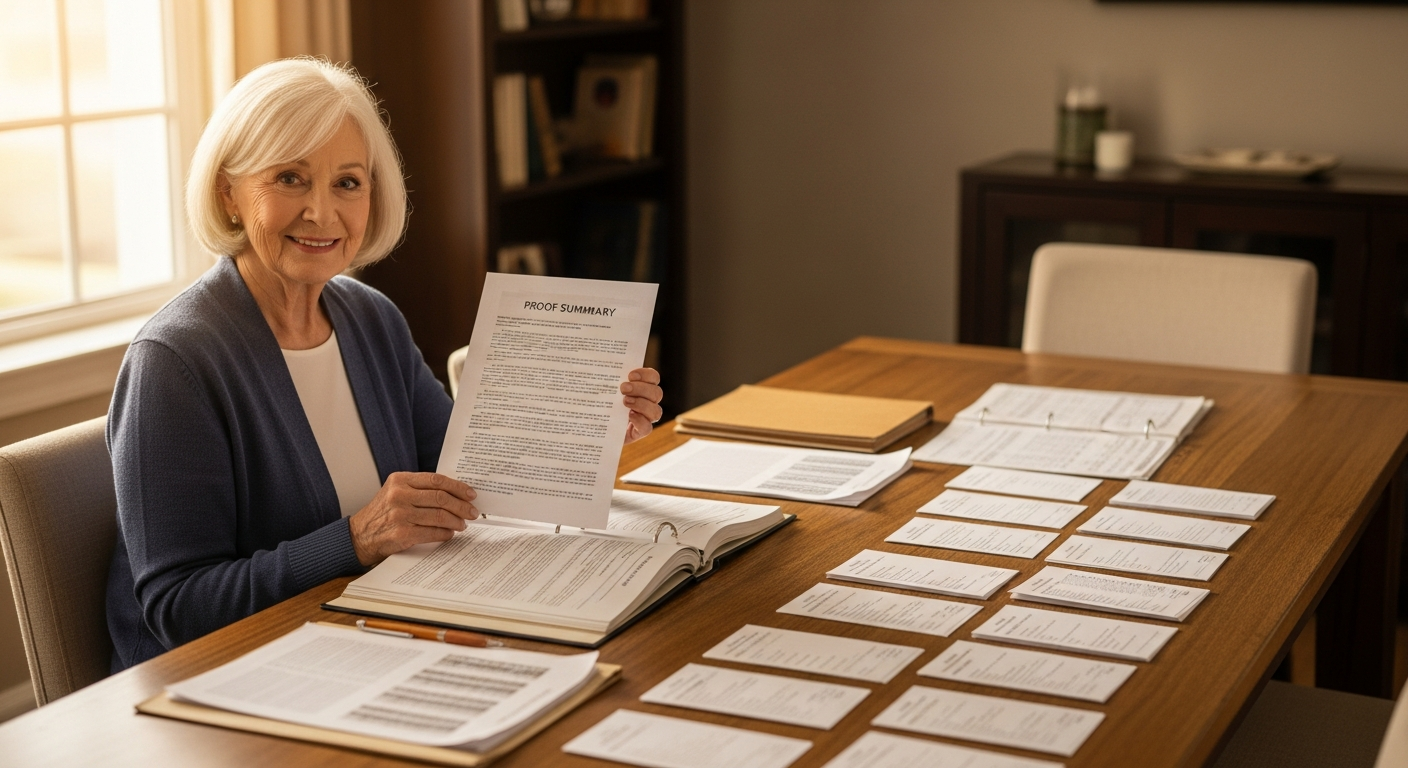
Mission 25: The Complete Genealogist — Your Volume 1 Capstone
There comes a moment in every investigation when Granny stops handing you tools and simply says: show me. This is that moment.
Twenty-four missions ago you didn’t know a census from a city directory, and you certainly didn’t trust yourself to read a faded marriage register without someone hovering over your shoulder. Look at you now. Somewhere between the biscuit tin and the brick wall, you became the person in the family who knows things—who can find an ancestor, follow them across a county line, and explain how you did it.
Here at the end of Volume 1, it is time for the graduation project. Not a test graded in red ink—a capstone you build, with your own hands, about an ancestor you choose. Everything you have learned converges on one real person.
Let’s walk across this stage together.
Pick Your One Ancestor
The first mistake every graduate wants to make is choosing “my whole tree.” Resist it. The capstone is not a marathon; it is one beautiful, well-run mile.
Choose one ancestor, then one research question about them. Not “tell me everything about Great-Grandma Ellen,” but something answerable: Who were her parents? Did she marry twice? Was she born in Ohio or Indiana, since the records disagree? A good choice is a great-grandparent whose origins are fuzzy or a couple whose marriage you have never proved.
The single question tells you when you are finished. Without a bounded question, you can research forever without knowing whether you have done enough. With one, you have a finish line.
Search Like You Mean It
Now run what professionals call a reasonably exhaustive search. It does not mean reading every document on Earth. It means examining a wide enough range of reliable sources that the chance of an undiscovered record overturning your conclusion becomes small. Reasonable, not infinite.
You already own the toolkit. Census records place the ancestor in a household. Vital records document births, marriages, and deaths. Newspapers provide obituaries and announcements. Probate and land records show what they owned and left behind. Church and military records add context. Cluster research follows the friends, associates, and neighbors who often crack the case.
For twenty-four missions these were separate lessons. Now they converge, like spokes meeting at the hub, on one human being. That convergence is what “complete genealogist” means.
Grade Your Work with the GPS
The Genealogical Proof Standard is a checklist for evaluating your own work:
- Reasonably exhaustive research across the sources that matter.
- Complete and accurate source citations for every fact.
- Reliable evidence, skillfully correlated across records.
- Contradictory evidence resolved.
- A soundly reasoned, clearly written conclusion.
When two records disagree—a census says she was 42 while a death certificate says 47—that is not failure. Resolving the conflict is the work. Weigh which source had better information, then explain why. That is genealogy.
Cite as you go, not in a guilty heap at the end. A good citation answers who created the record, what it is, when and where it comes from, and why it can be trusted. Digital tools can draft citations or transcribe difficult handwriting, but the tool is an assistant, never the genealogist. You own the interpretation and proofread every word.
Write It Down
A conclusion living only in your head is not proof. It is a hunch. The capstone deliverable is a proof summary.
A proof summary is appropriate when evidence is direct and points in the same direction—for example, parents named consistently across several records. One to three pages is normal; one page is the target. Structure it simply:
- An introduction stating the research question.
- A body walking through the evidence with citations.
- A conclusion answering the question plainly.
Its longer cousin, the proof argument, is used when evidence conflicts or no single source proves the fact. You do not need to write one today. Just know the term is waiting on a future shelf.
Your Capstone Assignment
Choose one ancestor. Write one research question. Run a reasonably exhaustive search across the Volume 1 toolkit. Grade your work against all five GPS elements, resolving conflicts and citing as you go. Then write the one-page proof summary—introduction, evidence, conclusion—and bundle it with your question, search log, and GPS self-check.
The downloadable worksheet walks you through every step, with a place for your name at the top.
That bundle is your capstone piece: physical proof that you are now a genealogist who finishes. You did not stumble into this. You trained for it, twenty-four missions deep, and earned every page.
Welcome to the club. There was never an entrance exam—only the work of your own hands.
Granny says: “You came to me not knowing a census from a city directory, and today you hand me a proof summary with your name on it. Go on, complete genealogist—file it in Volume 1 where it belongs.”