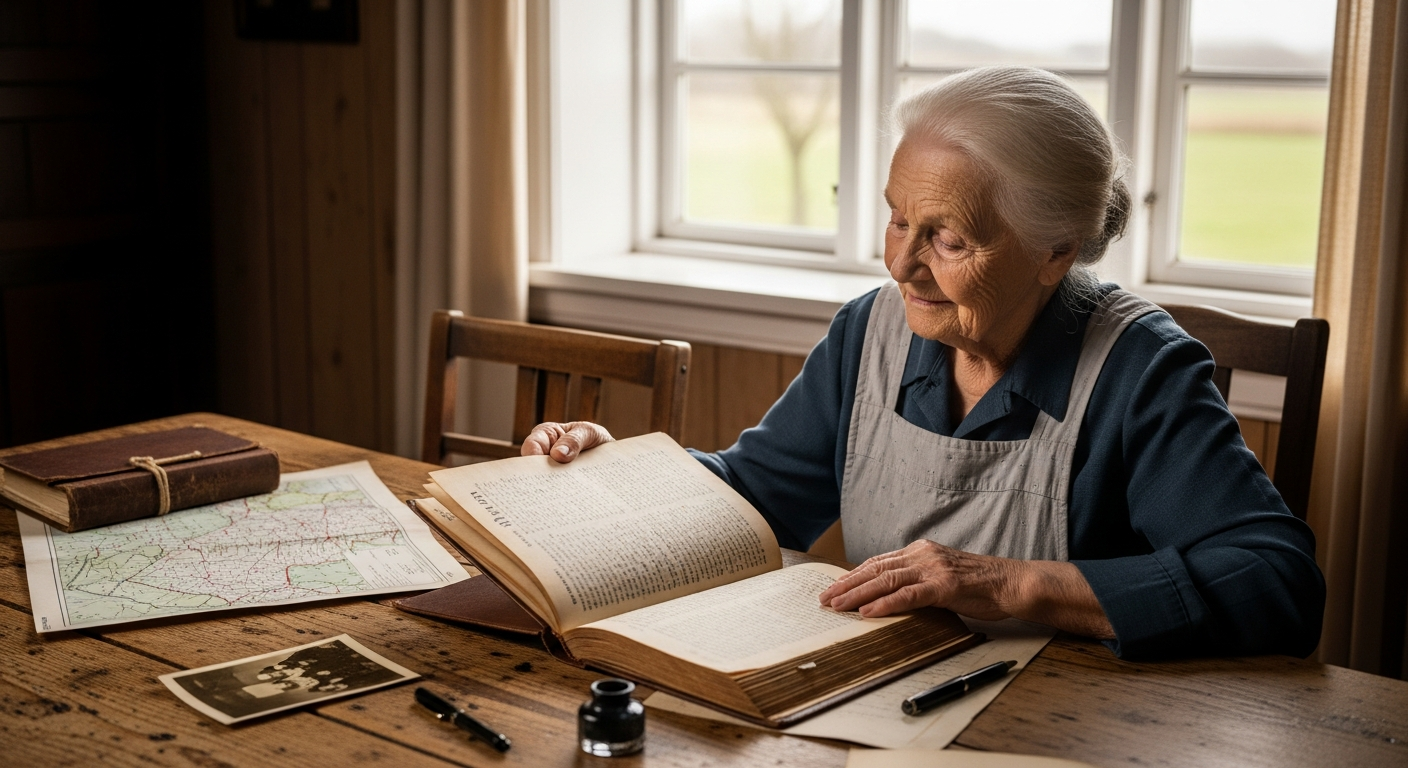
Mission 26: Crossing the Ocean — Scandinavian & Nordic Research
In the old country, a man named Lars had a son. The son’s last name was Larsson. If that sentence just gave you a headache, dear recruit, you’re exactly where you need to be.
Welcome to Volume 2. You’ve graduated. You followed an immigrant across the water, you learned to read a parish register, you watched borders slide around under your ancestors’ feet — and now we go further back and farther afield, to the homelands themselves. We’re starting where my own roots run deepest: the Nordic countries. This is Granny’s old country, and I’ll let you in on a secret — once you crack the naming system, Scandinavia is one of the most generous places on earth to be a genealogist. The Lutheran church wrote down nearly everybody for centuries, and Denmark, Sweden, and Norway have put mountains of those records online for free.
So pour yourself something warm, and let me take you home. We’ll trace one of my own — Rasmus Pedersen, who left Særslev parish on the island of Fyn in Denmark in 1866 — all the way back across the ocean. And I’ll warn you now: it’s a story that doesn’t end the way you’d hope. But the records tell it faithfully.
Why Your Great-Great-Grandfather’s Surname Lied to You
Here is the headache, and the aspirin for it, in one breath. In the old Nordic world, a surname was not a family name. It was a patronymic — fancy word, simple idea: it meant “father’s name plus son or daughter.” Lars’s son Anders was Anders Larsson (Sweden) or Anders Larsen (Denmark and Norway). Lars’s daughter Karen was Karen Larsdotter or Karen Larsdatter. And here’s the kicker: the name changed every single generation. Anders Larsson’s own son Per would be Per Andersson. Nobody inherited a fixed surname, because there wasn’t one to inherit.
So when you go looking for a family of “Larssons” marching neatly backward through the centuries, you will find no such family. You’ll find a chain — given name pointing to father’s given name, link after link. That chain is your path back. Don’t trace the surname; trace the pattern.
Now, the law dates, because they tell you exactly when the pattern breaks. In Denmark, an 1828 royal decree ordered fixed family surnames — and the countryside cheerfully ignored it, so an 1856 law had to re-mandate frozen surnames, with old patronymics lingering in rural areas into the 1870s. In Sweden, the 1901 Names Adoption Act formalized fixed surnames but didn’t ban patronymics; full mandatory family names didn’t actually arrive until 1963. The practical takeaway: somewhere around those dates, a real frozen surname appears, and behind it the old patronymic chain takes over. Knowing the date tells you when to stop expecting the surname to carry backward.
(And yes — at a Nordic family reunion you really can end up with three cousins all named Lars Larsson. The system was not designed with your spreadsheet in mind.)
The Gold in the Old Country: Church Books and Household Rolls
Here’s why I get a little proud about the homeland. The state Lutheran clergy recorded nearly everyone — and in two record types that are the envy of researchers everywhere.
The first is the parish register — the Danish and Norwegian kirkebøger / kirkebøker (literally “church books”). Baptisms, confirmations, marriages, burials, and people moving in and out of the parish. From 1812, Norwegian registers became standardized, with separate confirmation pages — and a confirmation is a lovely little “still alive, still here at fourteen-ish” checkpoint that helps you pin a person to a place and a year.
The second is Sweden’s crown jewel, the husförhörslängd — say it slowly, “household examination roll.” Beginning in 1686, the parish priest visited every household roughly once a year and wrote down the whole household: family, the servant girls and farmhands (pigor and drängar), each person’s birth date and birthplace, who moved in, who moved out, how well they could read, and sometimes a frank note on their conduct. It is, in effect, a rolling annual census stretching back over two centuries. Around 1894 it was replaced by the församlingsbok, but the gold runs deep. For a Danish line like the Pedersens, the parallel is the Danish census — and the 1860 census at Særslev, Skovby, Odense is exactly where we find them.
Where to Dig (Mostly for Free)
You do not need to spend a krone to start, and that still delights me. Let me hand you the real doorways.
For Denmark, go to Arkivalieronline, the free portal of the Danish National Archives (sa.dk) — more than a hundred million scanned images, including parish registers and censuses. For Norway, it’s Digitalarkivet (digitalarkivet.no), the National Archives of Norway, also free, with scanned and transcribed church books, censuses, and emigration lists. For Sweden, start at Riksarkivet’s Digitala forskarsalen (sok.riksarkivet.se), free, with searchable census databases. When an image is faded or you want richer indexes, reach for ArkivDigital (arkivdigital.net) — a paid subscription, but high-resolution color images and a quarter-billion index entries, and very often available free at your local library. Across all three countries, FamilySearch (free) and MyHeritage (paid) carry large Nordic collections too.
Then there’s the bridge across the water: emigration records. Denmark’s police kept emigration lists from 1869 to 1908, held at the Danish Emigration Archives in Aalborg, covering most who left. Sweden has the Emibas / Emigranten indexes. Norway’s lists live in Digitalarkivet. And if your ancestor joined the Church and sailed for Utah — as many Scandinavians did — the LDS Scandinavian Mission emigration records (1852–1920) are a treasure, covering Denmark, Norway, Sweden, Finland, and Iceland.
One more I love, especially for Norwegian lines: the bygdebok, a local-history book for a community, organized farm by farm. For each farm it lists, in order, the families who lived there — often vaulting you back many generations in an afternoon. Many are digitized at the Nasjonalbiblioteket (look for “Tilgang for alle” — open access). Sweden and Denmark have parallels in their parish and local histories.
The Pedersens: Tracing One Family Back Across the Water
Let me put it all together on a real one of mine. The Pedersens of Særslev parish, on the island of Fyn, in Odense Amt, Denmark.
We start on this side of the ocean — with the American records that tell the hardest part of the story first.
The Abner Lowry Company arrival record shows the surviving children entering Utah on October 22, 1866. But Rasmus Pedersen himself never arrived. He died on August 1, 1866 — on the plains, somewhere between Missouri and the Salt Lake Valley. His wife, Ane Marie Jespersen, outlasted him by exactly one month. She died September 1, 1866. Also on the plains. Their son Niels Christian, born in Maderup in 1854, died with them on the journey. Three of the family — buried somewhere on the American prairie, in unmarked ground, never seeing the valley they’d crossed an ocean to reach.
That’s the American record. Before you even open a Danish database, the story is already haunting.
Now we work backward. The family left Denmark as Latter-day Saint converts in 1866, and for that community the LDS Scandinavian Mission emigration records are the first bridge. From there we cross to Arkivalieronline — the Danish National Archives’ free portal — and pull up the 1860 Danish census at Særslev, Skovby, Odense. There they are: Rasmus, Ane Marie, and the children, in a farmstead in Maderup, recorded by the state exactly six years before they left.
The baptism records for the children are in the Maderup registers — Jasper and his twin Peder (who died as an infant in June 1847, just weeks after birth), Hans Peter, Niels Christian, Jens, and little Mette Marie. Each baptism entry names the father, and the father’s name is the key to the patronymic chain.
Rasmus is Pedersen — son of Peder. His father was Peder Knudsen, born 1794. Follow that backward: Peder Knudsen = Knutsen = son of Knut. Each generation, the surname changes, and each change is a breadcrumb pointing one father further back. Ane Marie is Jespersen — daughter of Jesper. Her father was Jesper Hansen, born 1789. Two chains, diverging, both legible in the parish registers if you know what you’re reading.
And then there’s the surname itself. The family crossed as Pedersen. They arrived — those who survived — as Petersen. The name shifted the moment they reached American soil, the way families sometimes change in the act of surviving. Pedersen to Petersen: the Old Country name refracted through a New World ear.
One honest warning for the climb into those older records: the registers are written in the old Gothic hand — flowing cursive Kurrent and blocky Fraktur letterforms. Don’t try to read sentences. Learn the alphabet shapes, then hunt for known target words — names, født for born, place-names. A couple of weeks of short daily practice, with FamilySearch’s Nordic Handwriting wiki at your elbow, and you’ll be reading an 1847 baptism entry with your own eyes.
Now — the last thread, and the one that I keep coming back to.
Jasper Pedersen, my 3rd-great grandfather, survived the crossing. He arrived in Utah, married in Salt Lake City in 1867, and built a life. But in 1887, he returned to Denmark on a mission for the Church — back across the ocean he and his parents had crossed to reach him a future. He died there. He crossed back over and never came home.
His parents left everything to get to Utah and never arrived. Jasper arrived, and then went back to the country they’d left, and didn’t return from that either. The family story is one long crossing, in two directions, and the records on both sides keep faithful account of every step.
GRANNY SAYS: The old country never quite lets go of its children — it just files them away, in a careful Lutheran hand, waiting for you to come knocking.
Your Mission
Your mission, should you choose to accept it: find the single U.S. record that names your Nordic ancestor’s home parish. Then open the matching national archive — Arkivalieronline, Digitalarkivet, or Riksarkivet — and locate that parish’s register. That’s it. One record, one archive, one door. The old country has been keeping the light on.
Mission Downloads
Ready to take a deeper dive? These resources will help:
Raising the Next Generation of Detectives
Every family historian started somewhere — and the best time to start is young. If there’s a child in your life, a son or daughter or grandkid or curious little niece, you don’t have to hand them patronymics and Gothic handwriting on day one. The Operation Granny Files Adventures Workbook turns the whole hunt into something they can actually do: family-tree maps to fill in, real records to decode, and a case of their very own to crack. Put the magnifying glass in their hands. The old country has been keeping the light on for them, too.