Mission 39: Raíces: Why Your Mexican Ancestors May Have Better Records Than Your English Ones
A reader wrote to me a few months ago, apologizing before she’d even asked her question. “I know this probably isn’t as interesting as the English lines,” she said, “but my dad’s side is from Jalisco, and the trail just says ‘Mexico’ on the ship manifest and then… nothing. I assume there’s nothing to find that far back.”
I want you to sit with that word — assume — because it’s doing a lot of quiet damage. She’d absorbed something every English-research genealogist eventually absorbs without anyone saying it out loud: records get thinner the further back you go, and by the 1700s you’re lucky to find scraps. That’s true for most Anglo-American lines. It is not true for hers. Her family’s parish began keeping baptism, marriage, and burial records in the 1600s — in some dioceses, the 1500s — a full two centuries before Mexico existed as a country and more than three centuries before it required anyone to register a birth with the state. She didn’t have a dead end. She had a filing cabinet nobody had told her about.
Why This Matters for Your Search
Here’s what you’ll be able to do by the end of this mission: identify whether your Hispanic or Mexican ancestor’s records live in a Catholic parish register, a civil registry office, or both — and read either one, even if you don’t speak Spanish. You’ll also learn the one naming convention that trips up nearly every English-language genealogy resource on this topic, and that, once you understand it, will hand you your ancestor’s mother’s maiden name for free, straight out of a single record. That’s not a small thing. It’s a problem OGF spent an entire mission solving for English and American lines. In Hispanic research, the records solve it for you.
The Parish Kept Score Long Before the Government Did
Spanish colonial law required every parish — from the earliest years of colonization — to record baptisms, marriages, and burials for everyone within its boundaries, and “everyone” is doing real work in that sentence: Indigenous parishioners and people of mixed ancestry are in these books too, not just Spanish colonists. FamilySearch’s own catalog shows how deep this runs. Mexico City’s collection covers 1514 to 1970. The state of México runs from 1567. Querétaro starts in 1590 and includes marriage investigation files alongside the baptisms and burials. For three hundred years, until Mexican independence in 1821 and well beyond it, the Catholic Church was Mexico’s only systematic record-keeper of births, marriages, and deaths — and it kept score with genuine consistency.
That’s the headline. Here’s the part that actually matters for your Tuesday-night research session: these records aren’t just old, they’re usable. Indexed. Digitized. Free, in most cases, on FamilySearch. That’s a meaningfully different proposition than “the records technically exist in an archive in Spain.”
Three practical things to know about a parish register before you open one. First, baptisms, marriages, and burials were typically kept in separate books — libros de bautismos, libros de matrimonios, libros de defunciones — so know which book you’re asking for. Second, the baptismal entry is usually your richest source, because Catholic practice encouraged baptism within days of birth, and the entry names the child, the date, both parents, and the godparents (padrinos). Third, don’t skip the pre-marriage investigation files — informaciones matrimoniales — where they survive. The Church required proof that a couple was free to marry, and the resulting witness testimony sometimes names grandparents who never made it into the marriage register at all. This is what genealogists mean by original, first-hand testimony as opposed to a later summary — the direct evidence sits in the investigation file, not just the tidy final entry.
A Name Trail: From a Border Crossing to a Baptismal Font
Let me show you how this actually runs, start to finish, using a composite example built from the kind of trail this mission is designed to teach. (Real names and phrasing below are illustrative — reviewed for accuracy in the underlying Spanish terminology and naming conventions before publication.)
Start with an American-side clue: a 1919 border-crossing manifest at El Paso names “Jose Ramirez, natural de Jalisco, México.” That’s a state, not yet a town — this is exactly the kind of record Mission 12 taught you to mine for a place name. A later naturalization petition narrows it further: “Degollado, Jalisco.” That single town name is the coordinate that unlocks everything downstream.
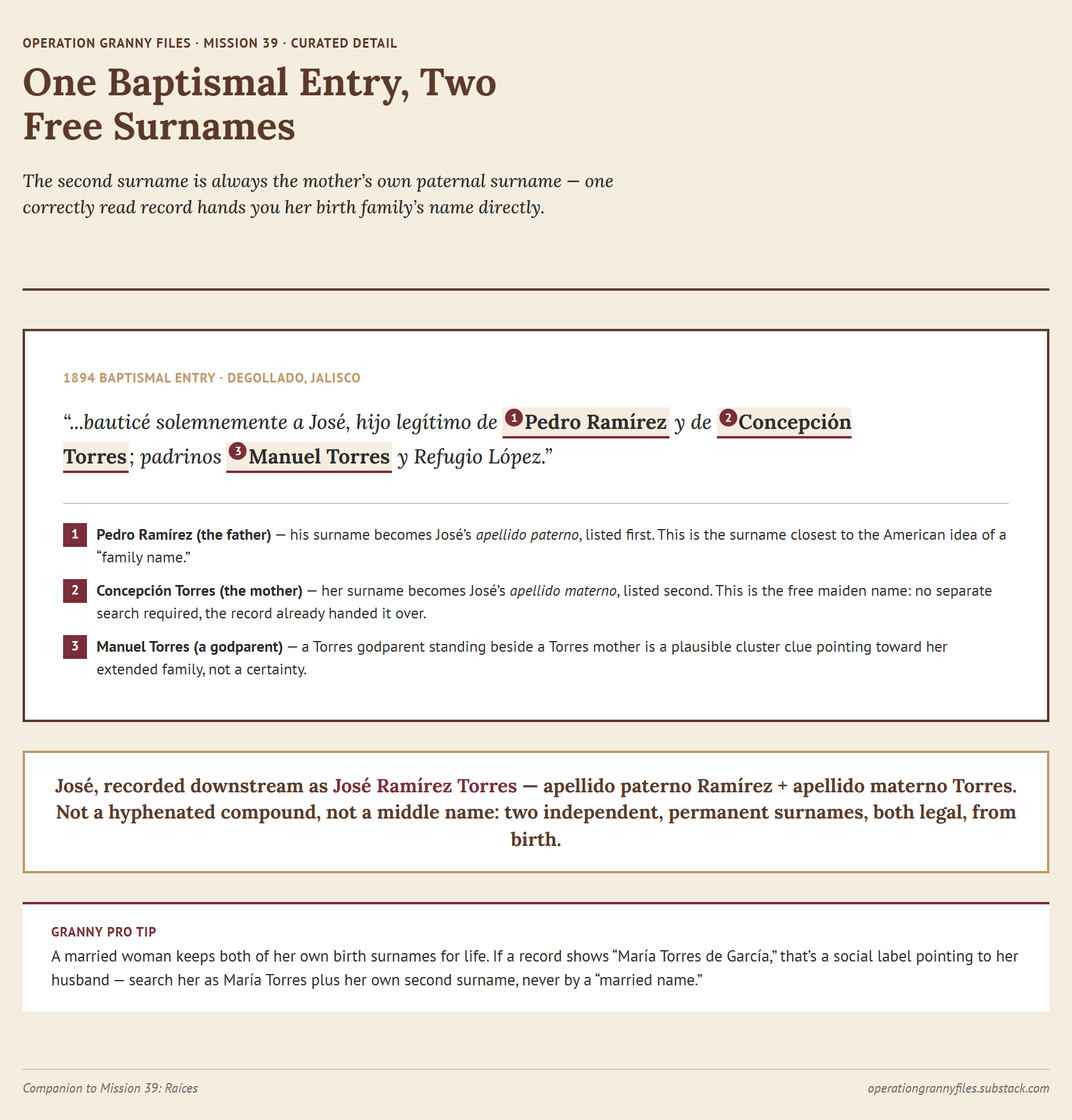
With “Degollado, Jalisco” in hand, you turn to FamilySearch’s Jalisco Catholic Church collection and find a baptismal entry: a priest, in March of 1894, baptizing a boy named José, legitimate son of Pedro Ramírez and Concepción Torres, with Manuel Torres and Refugio López standing as godparents. Read plainly, two things resolve immediately. José’s mother’s surname — Torres — arrives with no separate maiden-name hunt required; the record hands it to you. And a Torres godparent standing alongside a Torres mother is a plausible cluster clue pointing toward her extended family, the same cluster-research instinct Missions 9 and 31 already taught you to trust.
The trail keeps going. A 1919 Registro Civil marriage record — filed after José’s return from working in the United States — lists his full legal name as José Ramírez Torres, marrying María Hernández Solís. This civil record adds something the baptism didn’t carry: both sets of grandparents’ names. Church records tend to name godparents; civil records more often name grandparents. Check both, for any event after 1859, and you’re not being thorough for thoroughness’s sake — you’re recovering two different halves of the same family.
GRANNY PRO TIP: I nearly walked right past a woman in an index once because she was listed as “María Torres de García” in one record and “María Torres Alvarez” in another, and I assumed I had two different women. I didn’t. The “de García” was a social label — pointing to her husband, not a legal name change — and her actual, permanent legal name was the one with both her own birth surnames. In Spanish-language records, a woman keeps her own two surnames for life, married or not. If you’re searching for her, search her birth name, not a “married name” — because in this record system, there mostly isn’t one.
Reading the Registry: Civil Records and the Double-Surname System
Mexican civil registration began on paper on July 28, 1859, when President Benito Juárez established a civil registration office as part of the broader Reform-era separation of church and state. On paper is the key phrase — adoption was slow, and much of the population kept registering births and deaths through the parish out of habit, or resistance, or simple distance from a government office. Enforcement tightened after 1867, but even then, some municipios weren’t consistently registering vital events until the 1870s or 1880s. If your ancestor’s event falls in that gap, don’t assume a civil record exists just because the law was technically on the books. The parish register may be the only surviving record for that date, and it’s worth checking both anyway, since they often preserve different details of the same event.
Now, the naming convention — the one detail I want you to get exactly right, because it’s the fastest way to signal to a Spanish-speaking reader whether you actually understand this record system or you’re skimming a listicle. A person’s full name typically runs: given name, then the apellido paterno (father’s first surname, listed first), then the apellido materno (mother’s first surname, listed second). A child of Juan García Hernández and María Rodríguez López is recorded as García Rodríguez — not a hyphenated compound, not a married name, but two independent, permanent surnames that are part of that child’s legal identity from birth. Neither is a “middle name” in the American sense, and this convention traces back to Castilian practice from at least the sixteenth century.
For a genealogist, that structure is a gift. Because the second surname is the mother’s own paternal surname, one correctly read record often hands you her birth family’s name directly — no separate maiden-name search required. That’s the mirror image of the problem Mission 31 spent an entire post untangling for Anglo-American lines, where a married woman’s premarital surname routinely disappears from the record. Here, structurally, it mostly doesn’t.
How to Actually Do This: A Step-by-Step Starting Path
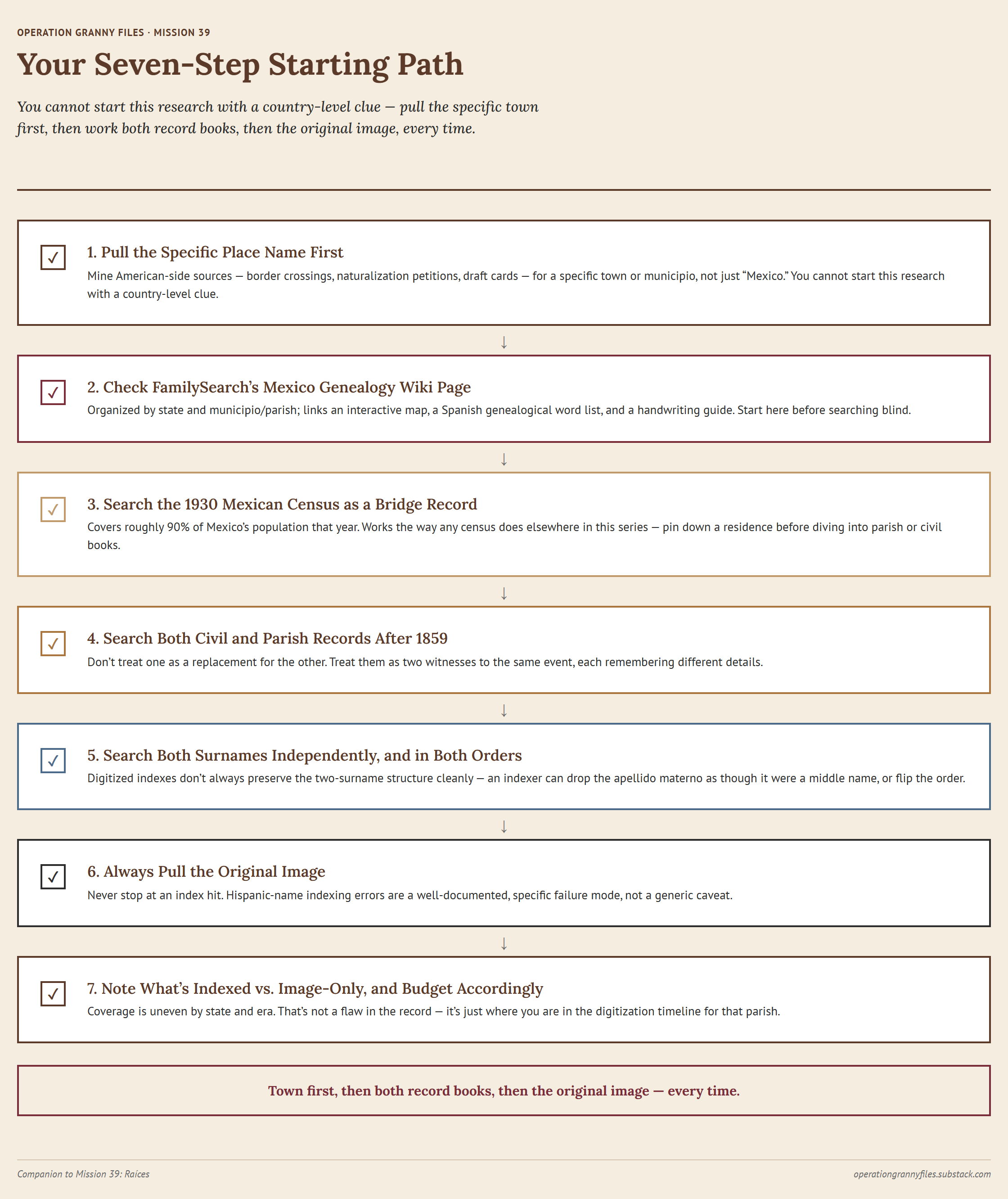
- Pull the specific place name first. Before you touch a parish or civil record, mine your American-side sources — border crossings, naturalization petitions, draft cards — for a specific town or municipio, not just “Mexico.” You cannot start this research with a country-level clue.
- Check FamilySearch’s Mexico Genealogy Wiki page. It organizes collections by state and municipio/parish, and links an interactive map, a Spanish genealogical word list, and a handwriting guide. Start here before searching blind.
- Search the 1930 Mexican census as a bridge record. It covers roughly 90% of Mexico’s population that year and works the way any census does for you elsewhere in this series — pin down a residence before diving into parish or civil books.
- Search both civil and parish records for anything after 1859. Don’t treat one as a replacement for the other. Treat them as two witnesses to the same event, each remembering different details.
- Search both surnames independently, and in both orders. Digitized indexes don’t always preserve the two-surname structure cleanly — an indexer working fast can drop the apellido materno as though it were a middle name, or flip the order.
- Always pull the original image. Never stop at an index hit. This is standard genealogical discipline everywhere, but Hispanic-name indexing errors are a well-documented, specific failure mode, not a generic caveat.
- Note which collections are indexed versus image-only, and budget accordingly. Coverage is uneven by state and era. Some collections are fully searchable by name; others require the kind of page-by-page browsing pre-index research has always demanded. That’s not a flaw in the record — it’s just where you are in the digitization timeline for that particular parish.
Where Beginners Go Wrong
The single most common mistake is treating the apellido materno as disposable — dropping it, alphabetizing by it, or assuming it’s a typo when it doesn’t match what you expected. It isn’t disposable. It’s half the identifying information in the name, and dropping it is how researchers lose their own ancestors inside a perfectly good record.
The second is assuming a married woman took her husband’s surname the way Anglo-American convention expects. She didn’t, legally. If you’re hunting for a “Mrs. García” and coming up empty, you’re very possibly searching for a name that never existed in any official record — her own two birth surnames are still what you want.
The third is treating “the record only goes back so far” as evidence of a dead end when it may simply mean you haven’t yet found the right diocese. Coverage genuinely varies — central Mexico’s dioceses often reach back to the 1500s, while northern frontier parishes, settled later, start centuries after that. A thin trail in one collection is not proof of a thin trail everywhere; it may just mean you’re looking at the wrong parish’s coverage window.
A Different Kind of Head Start
Most of what OGF teaches is how to keep going after the paper runs out — substitute records, cluster research, reading between the lines of what survived. This mission is a little different, because for a real share of this audience, the paper doesn’t run out anywhere near as fast as they’ve been led to expect. The parish that baptized your great-great-great-grandfather may have been keeping that same careful, formulaic record three hundred years before anyone in Washington or London thought to ask a citizen’s name.
That’s not a small correction to make to someone’s assumptions. It changes what a “brick wall” even means. A reader whose English line goes cold at 1750 and whose Mexican line goes cold at 1750 is not standing at the same wall — one of those walls has a door in it, and it’s been unlocked the whole time.
GRANNY SAYS: Don’t apologize for a “harder” line before you’ve even looked. Find the town, not just the country. Keep both of her surnames, always. And go check the parish before you decide the trail is cold — it was almost certainly still writing when your English cousins’ trail went dark.
Mission Downloads
Catch Up on the Series Browse every lesson in the Operation Granny Files mission archive.