Mission 40: The Family Historian’s Field Manual — Your Volume 2 Capstone
I’ve watched a lot of beginners become genealogists over the course of this series, and there’s a specific moment it happens: not when they find a breakthrough record, but when they build a system so they never lose one again. It doesn’t look dramatic from the outside — no gasp, no photograph clutched to the chest. It usually looks like someone opening a plain document, typing a date and a source and a single sentence about what they didn’t find, and closing the laptop without a second thought. That small, unglamorous act is the actual hinge point of this hobby — the difference between someone who occasionally looks something up and someone who runs a research practice. Volume 1 taught you to do the work. Volume 2 has spent fifteen missions teaching you to sustain it. This one ties the bow.
Why This Matters for Your Search
Here’s the bridge, plainly stated: everything you’ve learned since Mission 26 — the Nordic records, the DNA surprises, the church registers, the specialties you didn’t know you’d fall for — only compounds in value if you have somewhere to put it. A technique used once and forgotten is a party trick. A technique folded into a system is a permanent capability. This mission won’t teach you a single new record type. It teaches five pieces of infrastructure — a log, a citation standard, a chosen lane, a reference shelf, a maintenance rhythm — that turn fifteen missions of scattered skill into one durable practice.
The Log: What You Searched, Not Just What You Found
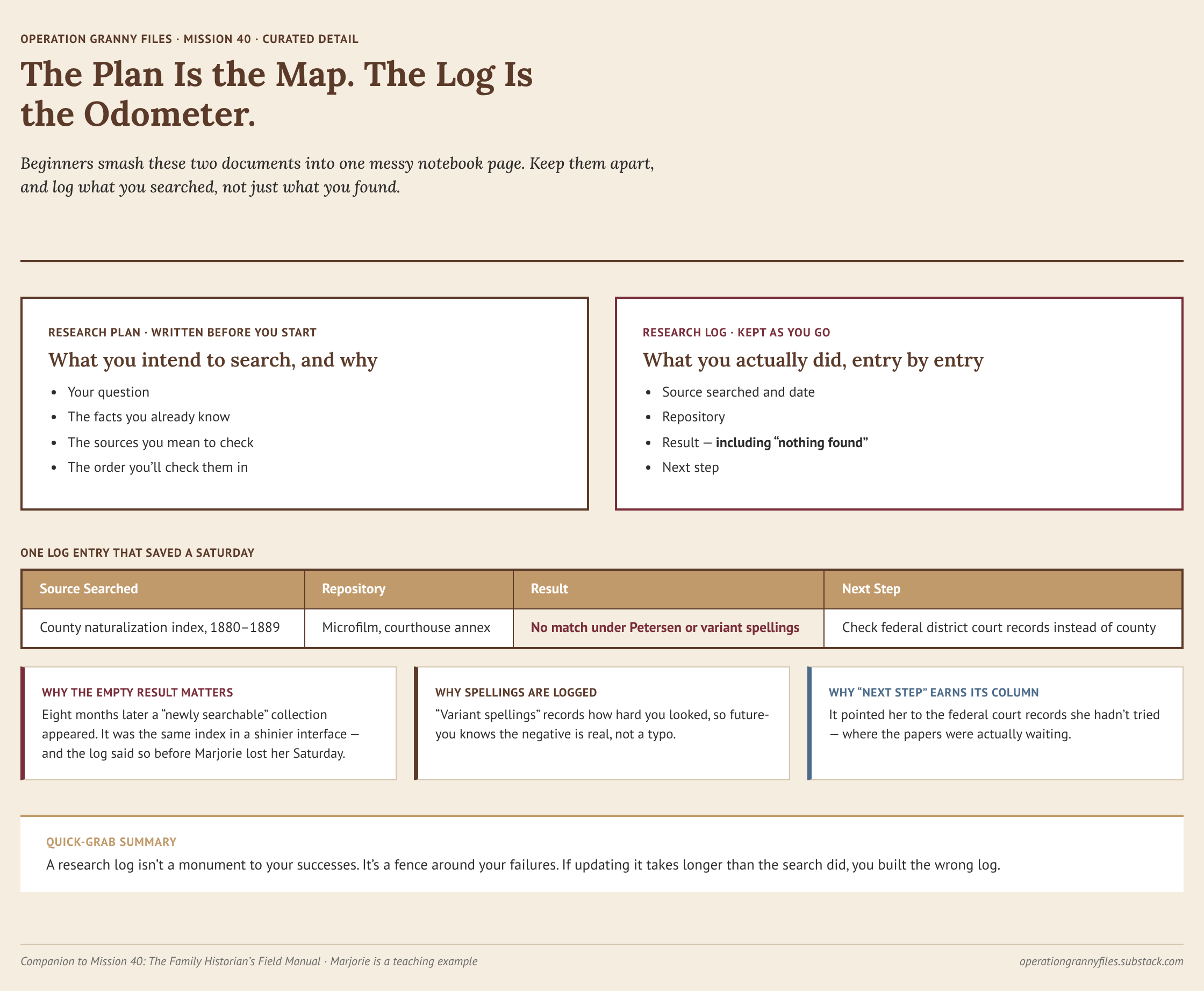
Most beginners treat “keeping notes” as an afterthought — something they’ll get around to once they’ve found something worth writing down. Here’s the reframe: a research log isn’t a record of what you found. It’s a record of what you searched, including the searches that came up empty. That second category is the one beginners never keep, and it’s the one they regret losing most.
Genealogists — the discipline traces most directly to Elizabeth Shown Mills’ research-planning methodology — separate two documents that beginners tend to smash together into one messy notebook page. A research plan is what you intend to search, and why, written before you start: your question, the facts you already know, the sources you mean to check, and the order you’ll check them in. A research log is what you actually did, entry by entry, as you go: source searched, date, repository, result, next step. The plan is the map. The log is the trip odometer.
Here’s why the distinction earns its keep. Without a log, you don’t just risk losing a discovery — you risk re-discovering your own dead ends. A newly digitized probate index lands online, you get excited, you search it, and you find nothing — only after an hour of frustrated clicking do you half-remember checking that exact index once before, in a different session, with the same empty result. The log is what prevents that hour. It’s not a monument to your successes. It’s a fence around your failures, so you don’t fall into the same ditch twice.
Granny’s confession: I went two full years without a real research log — just scattered notes in whatever document happened to be open at the time — and paid for it directly. I spent an entire Saturday re-searching a Missouri county’s land records for a Petersen ancestor, absolutely certain I hadn’t checked that book before, only to find my own handwriting in the margin of a printed page sitting in a folder from eighteen months earlier. Same book, same negative result, same afternoon lived twice. I built my first real log the following week, out of pure embarrassment.
Watch It Work: The Afternoon Marjorie Almost Lost Twice
Let me walk you through how this plays out for someone other than me. Say a reader — we’ll call her Marjorie, because every genealogist eventually becomes a Marjorie — has been chasing her great-great-grandfather’s naturalization papers for the better part of a year, applying earlier missions’ immigration-records lessons, and hit a wall: the county courthouse’s naturalization index for the 1880s doesn’t show his name.
Eight months later, a new digitized collection surfaces online: “1880s County Naturalization Records Now Searchable.” She nearly clears her whole Saturday to dive back in. But before she does, she checks the habit this mission is built around — her research log — and finds an entry from eight months earlier: searched county naturalization index (microfilm, courthouse annex), 1880-1889, no match under Petersen or variant spellings; next step: check federal district court records instead of county. She didn’t need to re-run the county search — the “new” collection was the same index she’d already exhausted, just wearing a shinier interface. Her log saved her Saturday, and pointed her toward the federal court records she hadn’t tried, where the actual naturalization papers turned out to be waiting.
That’s the log doing its real job. Not remembering what she found. Remembering what she’d already ruled out, so her curiosity could spend itself on genuinely new ground instead of familiar dead ends dressed up in new packaging.
Your Citation Standard, Not Everyone Else’s
This series has been teaching citation discipline implicitly since Mission 19’s Genealogical Proof Standard, without ever once asking you to sit down and formalize your own system. That debt comes due here.
Evidence Explained, Elizabeth Shown Mills’ landmark reference, is the field’s authoritative word on citation format, worth owning if you go deep in this hobby. But — and this matters most for a hobbyist audience — Mills herself has described citation as “an art, not a science.” The goal was never perfect adherence to a five-hundred-page style manual. The goal is a consistent, complete, personal standard you’ll still be using five years from now. A beautifully formal citation written out longhand once, inconsistently, is worth less than a simplified shorthand applied every single time without fail.
So build a one-page “my citation format” card, not a memorized manual. Cover the source types you actually cite most often — census records, vital records, church registers, probate files, online database entries — and write out, once, exactly how you’ll cite each one going forward. Consistency is the standard being taught here, not exhaustiveness.
Pick Your Lane (You Don’t Have to Pick Just One)
By this point you’ve been exposed to a genuinely wide menu across two volumes — general American records in Volume 1, then a deliberately varied slate of specialties across Missions 26 through 39: Nordic records, women’s records, records lost to disaster, AI-assisted transcription, DNA surprises, England and Wales, Ireland and Scotland, church records, shared-tree collaboration, colonial and pre-1850 work, Hispanic and Mexican research, and more.
Specialization is a natural next step, not an obligation. Most professional and semi-professional genealogists eventually develop deep expertise in one area — a geographic region, a record type, an ethnic-heritage specialty, genetic genealogy — rather than staying generalists forever. The National Genealogical Society counts developing a specialty among the marks of a maturing practice. Formal credentialing exists as a long-horizon option for anyone wanting a path beyond hobbyist status — the Board for Certification of Genealogists’ Certified Genealogist credential — but it isn’t required to have a real, valuable specialty. Most OGF readers will specialize the ordinary way: by noticing which mission they bookmarked to revisit, and following that thread.
Building the Shelf You’ll Actually Use
Every specialty comes with its own core references, and this mission’s job isn’t to hand you an exhaustive list — that would date badly and duplicate what the specialty missions already did. It’s to teach the habit: a small, curated shelf kept current and revisited on purpose, not assembled once in a burst of enthusiasm and never opened again.
Three anchors belong on every shelf regardless of specialty: the FamilySearch Research Wiki (free, continuously updated, organized by place and record type — your right first stop for any new specialty), Evidence Explained (your standing citation reference no matter the lane), and a specialty-specific society for ongoing community and updated guidance rather than a one-time resource.
Keeping the System Alive
Every piece of infrastructure this mission has introduced — the log, the citation standard, the backup routine you built in Mission 30 — degrades without a recurring rhythm to revisit it. The fix is the same trick Mission 30 taught for backups: tie maintenance to a memorable recurring date instead of trusting willpower.
A quarterly or annual log review (are there stale open questions worth revisiting now that new records exist?), an annual shelf refresh (has a new edition or resource appeared in your specialty?), and a periodic check-in on your Mission 30 “if I’m gone tomorrow” document (has anything material changed?) — attach each to a birthday, a New Year’s resolution, an anniversary, anything you’ll actually notice on the calendar. This cadence is the difference between a research practice and a research project you finished once.
GRANNY PRO TIP: Source-quality habit, carried forward from earlier in the volume — when you log a search result, note whether the record you checked was original or derivative, and whether the information in it was primary or secondary. A one-word flag in your log entry now saves you a much longer re-evaluation later, when you’re trying to remember why you trusted (or didn’t trust) a particular source.
Writing Someone Else Into the Practice
This is where the graduation framing earns its keep most directly. A research practice built with a log, a citation standard, and reference-shelf habits isn’t just more effective for you right now — it’s dramatically easier to hand to someone else, because the next person inherits a legible system instead of a pile of undocumented findings.
This builds directly on two missions you’ve already completed rather than repeating either. Mission 30 gave you the “if I’m gone tomorrow” document — who inherits the work, where everything lives. Mission 36 taught you how to bring a young family member into the work in the first place, one bounded mystery at a time. The handoff isn’t an end-of-life event you plan for once and forget. It’s an ongoing openness — keeping your practice legible enough that someone else could step in without reconstructing your thinking from scratch. If Mission 36 gave you a kid who’s caught the bug, this is what you’re handing them: not a shoebox of undocumented photographs, but a working system.
Set Up Your Own Field Manual, Step by Step
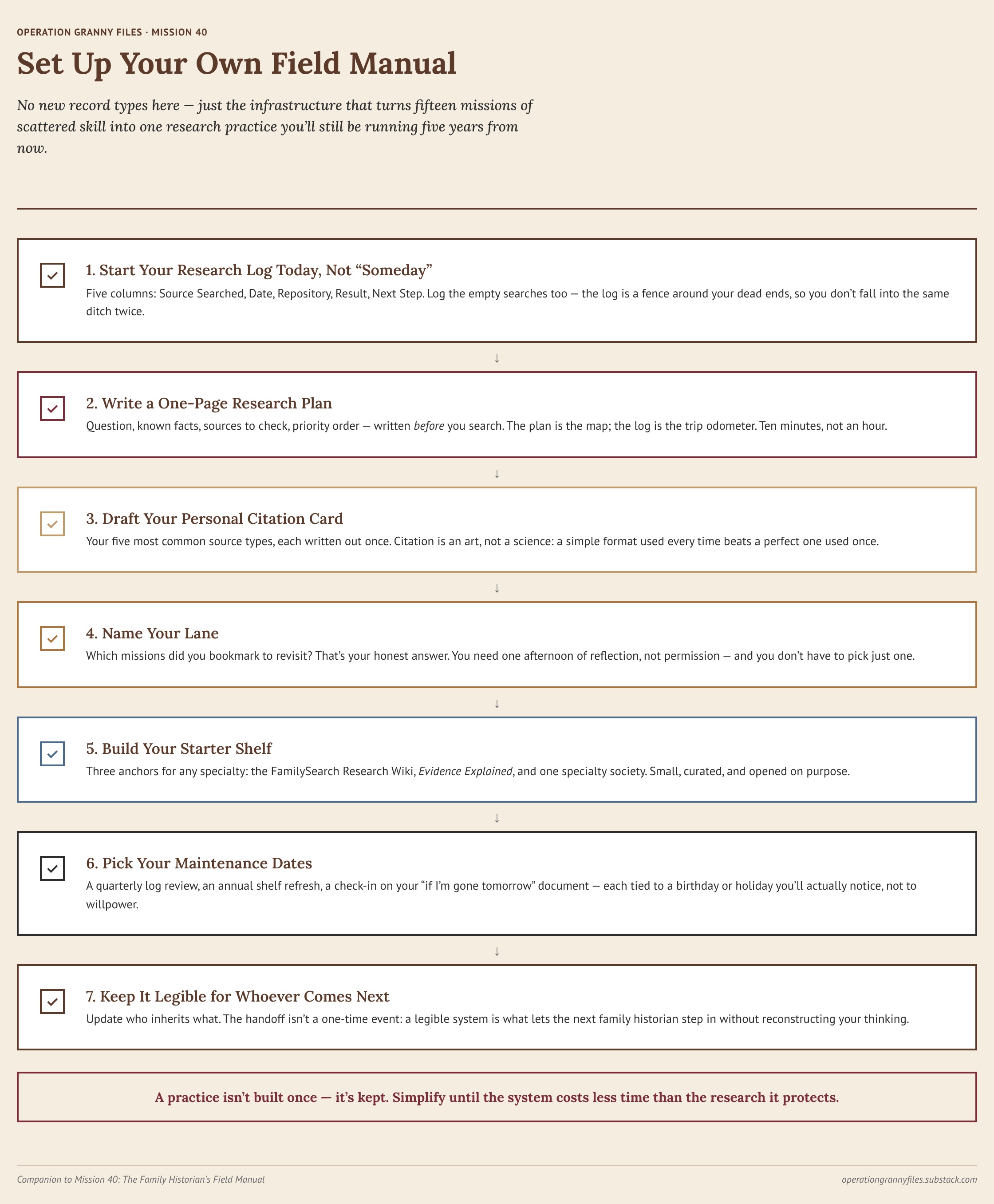
- Start your research log today, not “someday.” A bare spreadsheet with five columns — Source Searched, Date, Repository, Result, Next Step — beats the best system you haven’t started yet.
- Write a one-page research plan for your current open question. Question, known facts, sources to check, priority order. Ten minutes, not an hour.
- Draft your personal citation card. Pick your five most common source types and write out, once, how you’ll cite each from now on.
- Name your lane. Look back at which Missions 26-39 you bookmarked to revisit — that’s your honest answer, no dramatic decision required.
- Build your starter shelf. FamilySearch Wiki, Evidence Explained, one specialty society. Add to it as you go.
- Pick your maintenance dates. Attach a quarterly log review, an annual shelf refresh, and a Mission 30 check-in to calendar dates you’ll actually notice.
- Revisit your Mission 30 document and, if it applies, your Mission 36 relationship. Update who inherits what, so whoever’s catching the bug next has a way in.
Where Beginners Go Wrong
The most common mistake here isn’t skipping the system — it’s building an elaborate one and abandoning it inside a month because it demanded too much upkeep. If your log takes fifteen minutes to update after a ten-minute search session, you built the wrong log. Simplify until the system costs less time than the research it protects.
The second mistake is treating the citation card as a one-time assignment instead of a living document — revise it the moment a pattern stops working. Consistency going forward matters more than perfection on day one.
And the third: waiting to “feel ready” before choosing a specialty, as though there’s a right answer waiting to be discovered rather than a genuine preference waiting to be noticed. You need one honest afternoon reflecting on which missions you actually enjoyed, not permission.
The Part Where We Look Back
You started this series not knowing what a census was. Somewhere around Mission 25, you proved you could take that knowledge and run one ancestor’s case to the ground — carefully, thoroughly, with real proof behind your conclusions. Volume 2 asked something different of you: not “can you do the work,” but “can you keep doing it, for years, without me standing over your shoulder.” Fifteen missions later, the answer is yes, and the field manual you’ve just built is the proof.
Before you close this one out, take a few minutes with the Volume 2 competency self-assessment in this mission’s artifact. It isn’t a test — there’s no passing score. It’s a “look how far you’ve come” instrument, laying out plainly everything you’ve picked up since Mission 26: the specialties you’ve sampled, the proof-standard discipline from Mission 19, and now the system-building habits from this mission itself. Fill it in honestly, and be a little surprised by yourself.
I’ll say this once, and mean it: this is the biggest close of the volume, on purpose. Fifteen missions is a lot of Saturdays. You now own more citation opinions than most people acquire in a lifetime, and I mean that as the highest compliment. What comes next for Volume 3 is a conversation for another day — I’ll bring it to you separately once it’s ready. For now, close your log, note today’s date, and know the next entry is entirely yours to write.
GRANNY SAYS: A research practice isn’t the one you build once. It’s the one you keep — and today, you finally built one worth keeping.
Sources / Further Reading: Elizabeth Shown Mills, Evidence Explained: Citing History Sources from Artifacts to Cyberspace (Genealogical Publishing Co.; current edition) and her Evidence Explained QuickSheets on research planning and analysis; the Board for Certification of Genealogists, Genealogy Standards (the source of the Genealogical Proof Standard introduced in Mission 19); the FamilySearch Research Wiki (wiki.familysearch.org), organized by place and record type; and the National Genealogical Society’s Research in the States series and its guide to research logs and planning. Everything else in this mission is synthesis of Missions 19, 26-39, and 30 — see those posts for their own source trails.
If today’s mission left you wanting a hands-on way to build these same habits with a younger family member, our Homeschool Workbook series carries this same detective-work spirit into structured units your grandkids can work through on their own — a natural next stop once the system above is running.
Mission Downloads
Catch Up on the Series Browse every lesson in the Operation Granny Files mission archive.