Mission 38: The Norwegian/Danish Line — Deep Research in Scandinavia’s Secondary Records
You’ve found the parish. You know exactly where your ancestor lived — the name of it, the county, the years. Then you open the first church book and discover something nobody quite prepared you for: three hundred years of records written in gothic cursive, in Danish, organized around a naming system that changes every single generation. You stare at the image. You squint. You close the laptop.
Here’s what Granny knows. That moment — between finding the parish and actually reading what’s inside it — is where most researchers stop. Not because they lack courage. They stop because the records genuinely look impossible.
This mission is what happens next.
Where Mission 26 Ended, This One Begins
Mission 26 taught you how to cross the ocean: how to take an American record and work backward to a Scandinavian emigrant and the parish he left. That was the hard part, and you delivered. This mission doesn’t repeat it. We start on the far side of the water, parish already in hand, and go down instead of across.
And going down is worth it. Norwegian and Danish parish registers are richer, more detailed, and more systematically kept than the vital records of almost anywhere else in the world. You are not looking at a single birth certificate. You are looking at three centuries of continuous record-keeping about the same handful of farms.
But that richness only pays out if you can read it.
What Makes These Registers Different
For roughly three hundred years, the Lutheran state church was the sole keeper of vital records in both countries. Parish clergy were required to maintain kirkebøker (Norwegian) or kirkebøger (Danish) — church books — recording baptisms, marriages, burials, and confirmations. So far, so European.
What made these registers genuinely different was the in-migration and out-migration columns. Every time someone moved into the parish, the register recorded it. Every time someone moved out, the register recorded that too, and named where they went. Your ancestor didn’t simply vanish from the record when he moved to the next farm, the way he would in most systems. Instead the register said: Ole Hansen moved out, went to parish X. That’s a research road map — a highway system somebody else built three hundred years ago, leading exactly where you’re going.
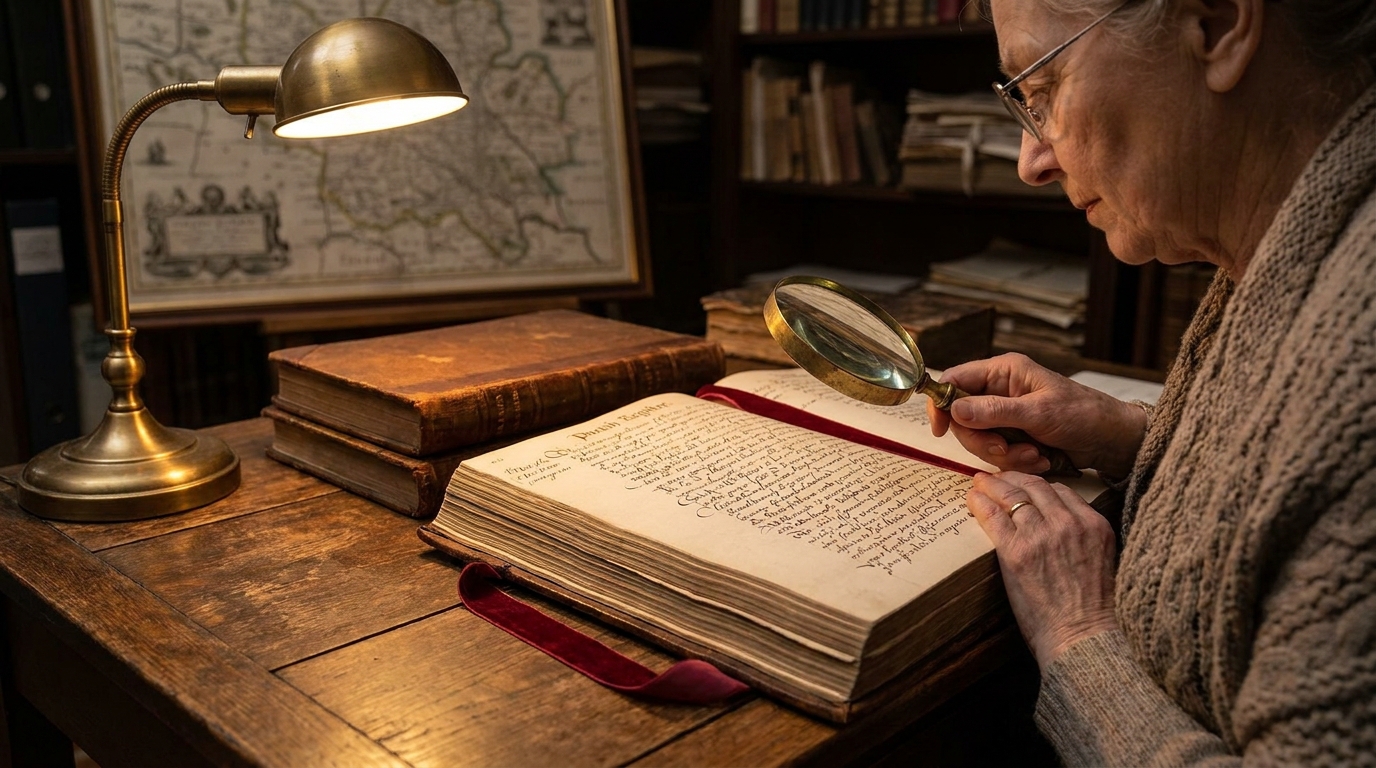
There’s a second structural gift. Most Norwegian and Danish parishes kept two copies of the register. In Norway the parish priest kept the official ministerialbok and the parish clerk, the klokker, kept a duplicate called the klokkerbok. In Denmark you have the hovedministerialbog (main register) and the kontraministerialbog (the duplicate, historically sent to the diocese for oversight). Here’s the practical magic: when one register’s page is water-stained, torn, or nearly illegible — common enough over three centuries — the twin often survives intact. A damaged page is not a dead end. It’s a prompt to go check the other book.
The Handwriting Problem, and the Modern Fix
Let’s name the barrier plainly. Eighteenth- and nineteenth-century Norwegian and Danish clergy wrote in kurrentschrift, a running cursive hand descended from German gothic script. It is genuinely unreadable to an untrained eye. The letters don’t look like modern Latin letters. Even when you know the language and the abbreviations, the handwriting alone can stop you cold for months.
Granny got this wrong once. I spent two years staring at a Norwegian farm register, guessing at names, before someone finally showed me how to trace the individual letterforms back to a paleography guide. Two years. And that was with somebody pushing me.
Here’s what’s different now. FamilySearch’s Full-Text Search includes AI transcription of historical Scandinavian-language handwritten records. You no longer have to learn paleography cold. You run the image through Full-Text Search — covered in detail in Mission 32 — the AI produces a machine transcript, and you check that transcript against the image with your own eyes. That single change removes the largest practical barrier standing between a beginner and deep Norwegian/Danish research.
The second barrier is just as real: the language. Entries are in Danish — formal, centuries-old Danish, thick with abbreviations and legal terms — and whatever Latin-based genealogy vocabulary you picked up in earlier missions won’t help you much here. But you don’t need fluency. You need to recognize roughly forty abbreviations, understand how a baptism entry is structured versus a marriage entry, and know what to ask once you’ve found someone. That’s a weekend of study, not a degree.
Ole, Son of Hans, Who Lived at Bakken
This is the hardest section in the mission and the most important one. Norwegian and Danish genealogy hinges on patronymic naming and on farm names. Get this wrong and one ancestor dissolves into three strangers. Get it right and three centuries of records suddenly tell a single continuous family story.
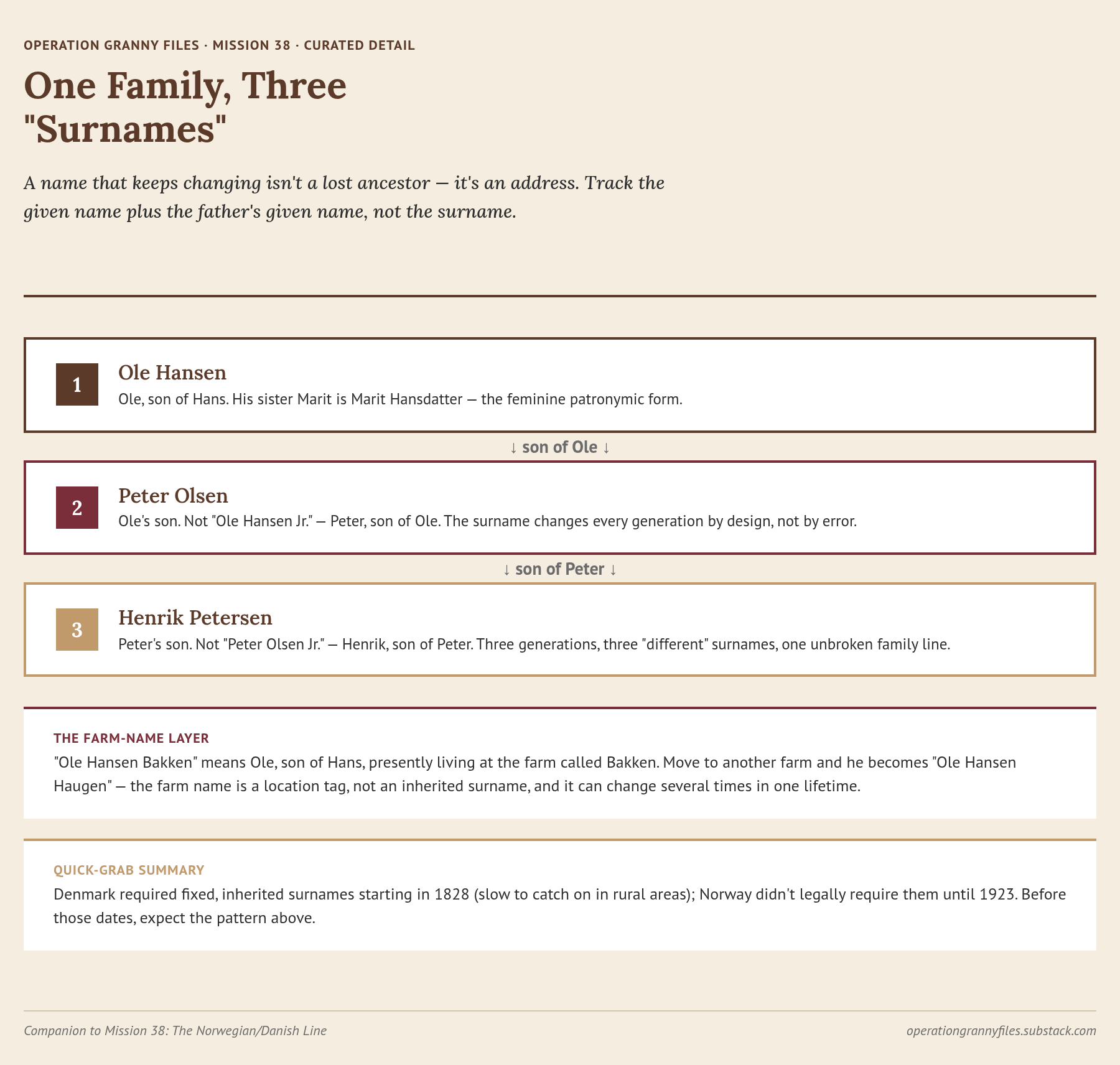
Through most of the eighteenth and nineteenth centuries, ordinary Norwegians used a patronymic naming system. Your second name wasn’t inherited; it was generated from your father’s given name. Ole, son of Hans, was Ole Hansen. His sister Marit was Marit Hansdatter. But Ole’s son wasn’t Ole Hansen Jr. He was Peter Olsen — Peter, son of Ole. And Peter’s own son wasn’t Peter Olsen Jr. He was Henrik Petersen. Three generations, three “different” surnames, one unbroken family line.
Denmark’s system ran nearly identically until the name law of 1828 began requiring fixed, inherited family names. It took decades to catch on; rural Denmark kept patronymics well into the mid-1800s. Norway held on longer still — patronymic naming remained common in rural districts late into the nineteenth century, and Norway didn’t legally require fixed surnames until 1923.
So here is the practical rule: don’t track the surname. Track the given name plus the father’s given name. “Ole Hansen” and “Peter Olsen” are the same family. You find them by remembering that Ole had a son named Peter, and that Peter’s patronymic must therefore be “son of Ole” — so you’re hunting for Peter Olsen, or Peder Olsen, because yes, those spelling variations are real and constant.
Farm names add a second layer. Most rural Norwegians used the name of the farm where they currently lived as a de facto third name element, hung on the end of the patronymic. “Ole Hansen Bakken” meant Ole, son of Hans, presently living at the farm called Bakken. Move to another farm and he became Ole Hansen Haugen. Move again and he became something else. The farm name changed every time he moved, sometimes several times in one lifetime, because it was a location tag, not an inherited surname.
Here’s a worked example. You find a baptism entry from 1870: “Anna Petersen, born to Peter Olsen Bakken and Ingrid.” Good — you have names. Fast-forward twenty years and you find an 1890 probate record listing a widow, “Ingrid Johnsdatter Haugen.” First instinct: different woman. Wrong instinct. That’s the same Ingrid. Her patronymic was always Johnsdatter — daughter of a man named John — it simply wasn’t written out in the 1870 baptism entry, where the clerk recorded her as the mother and nothing more. What actually changed was the farm. She lived at Bakken while Peter was alive, and after his death she moved to her brother’s place at Haugen, so the 1890 record tagged her with the farm she was standing on.
That’s the whole trick. The name looks like chaos and is actually an address. Once you see it that way, the registers turn transparent.
The Census Bridge
You’ve got a name, a farm, and a parish. But the registers span centuries and are organized by event, not by person. You need something to narrow the window.
That’s the census. Norway ran a series of genuinely excellent nominative — name-based — censuses in 1801, 1865, 1875, 1891 (partial), 1900, and 1910, all digitized and indexed. Denmark started earlier and ran them more often: 1787, 1801, 1834, 1840, then roughly every five years into the early twentieth century. Norway’s 1910 census is the prize, because it recorded full birth dates, not just birth years. Find your ancestor there and you have pinpointed the exact register page you need.
So the flow is: start with the census, confirm the parish and the farm, narrow the birth year. Then go hunting in the church books. The census takes you from cold to warm. The church books take you from warm to gold.
Beyond the Church Book: Three Records That Confirm a Family
Once you’ve mastered the kirkebog, three record classes reward the depth this mission promises.
Skifteprotokoller — probate and estate-division records — are the Norwegian and Danish counterpart to the American probate files from Mission 14. When someone died, the court oversaw division of the estate and the record named every heir and their relationship to the deceased. One skifteprotokoll can confirm an entire family group — children, spouses, siblings — in a single document.
Legdsruller, the military levying and conscription rolls, recorded every eligible man by name, birth year, and farm address. They’re gold for confirming a birth year independently, and for tracking a young man’s residence through the gap years between confirmation and marriage, when he’d otherwise vanish.
Tinglysning, deed registration through the local court, documented who actually held title to a given farm. That speaks directly to your farm-name puzzle: when three different Ole Hansens turn up across thirty years in the same district, knowing who owned which farm in which year tells you which Ole is yours.
When Two Registers Disagree
Sooner or later you’ll find two dates for the same event. One register says the baptism was January 12; the other says January 14. The instinct is panic. One of these has to be wrong, and if I pick wrong, my whole tree is wrong.
That’s almost never what’s happening. You’re not looking at an error. You’re looking at ordinary record-keeping from three hundred years ago. The ministerialbok and the klokkerbok — or the hovedministerialbog and kontraministerialbog — were maintained by different hands on different schedules. One might note the home christening, the other the church baptism two days later. One might list the father’s farm, the other the midwife’s name. Same event, two administrative systems.
The Genealogical Proof Standard, the framework serious genealogists use to confirm an identity, expects exactly this. When you hit a conflict, you haven’t lost the trail — you’ve found a research question. List both pieces of evidence. Note which is direct and which is derivative. Say plainly why one is your working hypothesis. Keep the other on file for the day new evidence arrives. That isn’t hedging. That’s documenting your thinking, and it’s what makes your conclusion defensible to anyone who reads it later, including you.
Your Norwegian/Danish Sequence, Step by Step
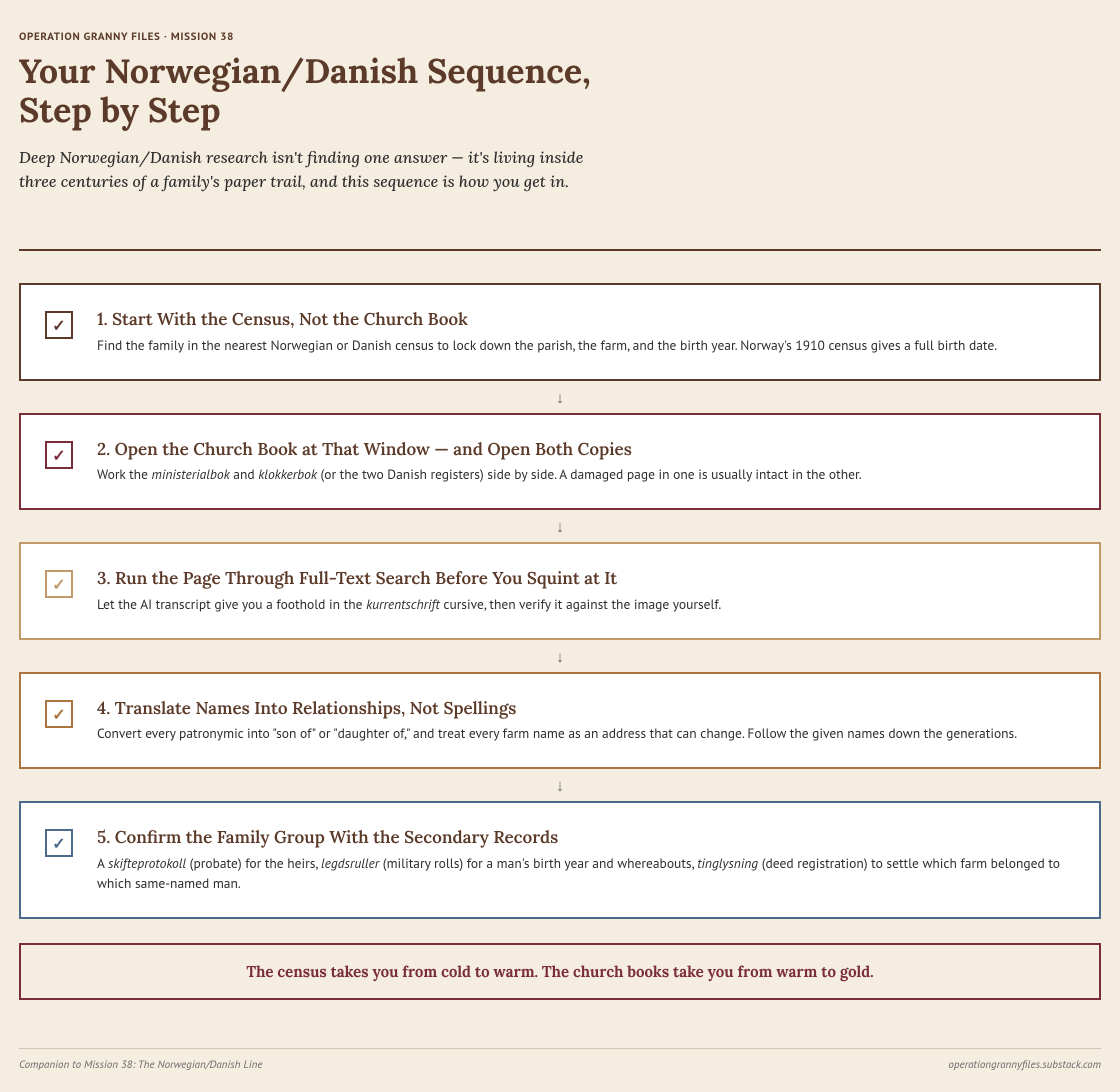
When you’re standing at the edge of a known parish, work these in order.
- Start with the census, not the church book. Find the family in the nearest Norwegian or Danish census to lock down the parish, the farm, and the birth year. Norway’s 1910 gives you a full birth date.
- Open the church book at that window — and open both copies. Work the ministerialbok and the klokkerbok (or the two Danish registers) side by side. A damaged page in one is usually intact in the other.
- Run the page through Full-Text Search before you squint at it. Let the AI transcript give you a foothold in the kurrentschrift, then verify it against the image yourself.
- Translate names into relationships, not spellings. Convert every patronymic into “son of” or “daughter of,” and treat every farm name as an address that can change. Follow the given names down the generations.
- Confirm the family group with the secondary records. A skifteprotokoll for the heirs, legdsruller for a man’s birth year and whereabouts, tinglysning to settle which farm belonged to which Ole.
Knowing a Place, Not Just a Name
English-language genealogy tends to be a puzzle with a defined answer. Collect enough records, find the name, move on.
Deep Norwegian and Danish research is a different animal. It isn’t finding the answer; it’s living inside three centuries of one family’s paper trail. It’s finding Ole in the 1801 census at Bakken, opening the kirkebog, and tracing forty years of confirmations and marriages and children as the farm name beside his name stays put — or shifts, and tells you he moved. It’s finding his son in the legdsruller, conscripted in 1885 from a farm you’d never heard of, and realizing he wasn’t lost at all: he was working that year as a hired hand on his uncle’s place. It’s opening a skifteprotokoll from 1912 and reading that a widow and five children inherited the whole farm.
That’s not genealogy as detective work. That’s genealogy as knowing a place. You end up documenting not just who a family was but how they lived — what they owned, who their neighbors were, what happened when someone died. That kind of depth lets you write the history instead of just the tree.
GRANNY SAYS: Three surnames, three farms, one family — in Norway and Denmark, a name that keeps changing isn’t a lost ancestor, it’s an address.
The Puzzle That Teaches Itself
Patronymics are the rare piece of genealogy that a ten-year-old grasps faster than an adult does, because a child hasn’t yet learned to expect surnames to hold still. Tell them Ole’s son is Peter Olsen and Peter’s son is Henrik Petersen, and they’ll have the rule cold in about ninety seconds — then start cheerfully generating their own name three generations back. The Operation Granny Files Homeschool Workbook turns that into a real exercise: a patronymic decoder, a farm-name puzzle built on a Norwegian family across four generations, and a place to write out what the young researcher’s own name would have been under the old system. Hand it over and let them beat you to the answer. They usually will.
Mission Downloads
Catch Up on the Series Browse every lesson in the Operation Granny Files mission archive.