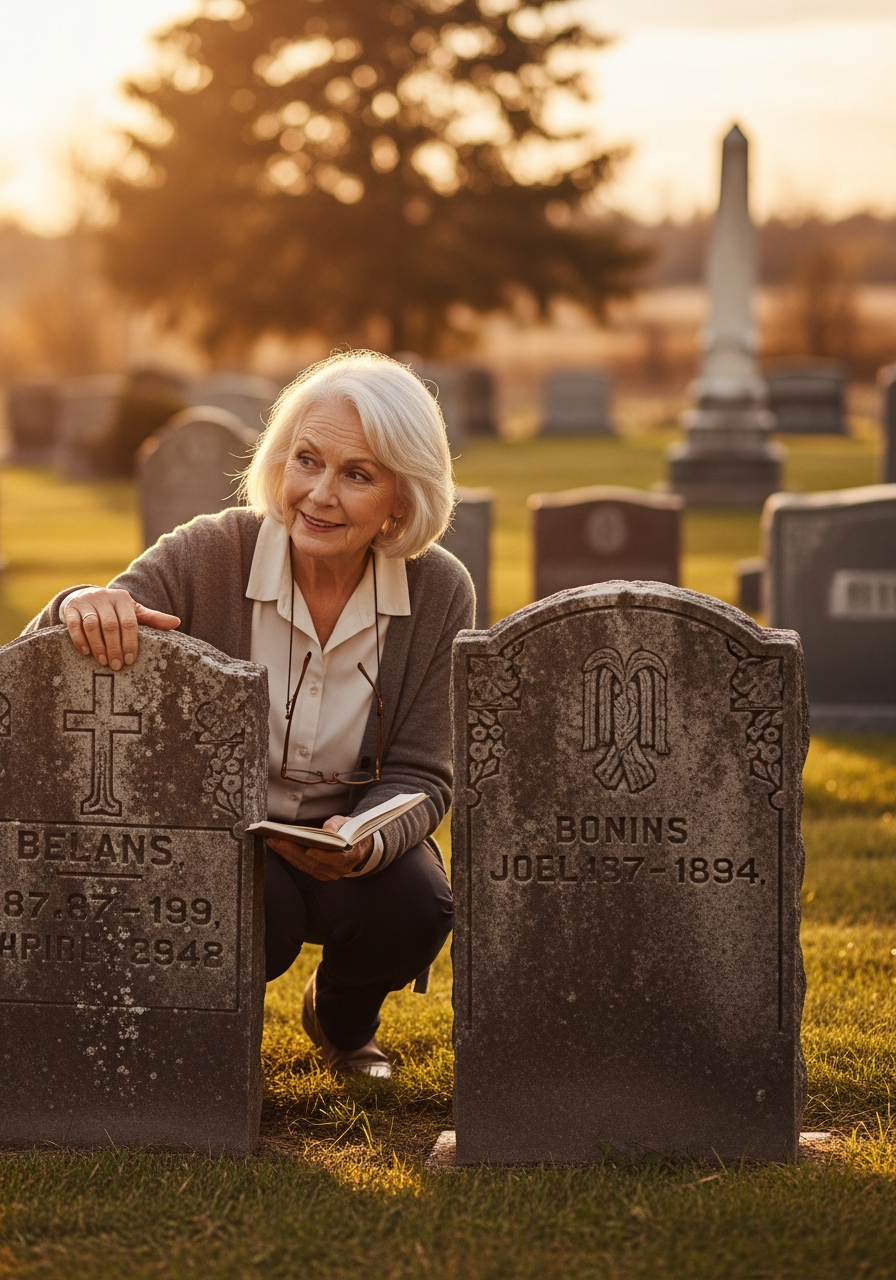
Mission 28: Graveside Intelligence — Cemetery Records & What the Stones Tell
There’s a particular kind of quiet you only find standing in a family plot. I was in one a few years back — a little country cemetery, grass gone gold at the edges, the kind of place where the wind does most of the talking. And I noticed something. The stones weren’t scattered. They were arranged. Grandpa and Grandma shoulder to shoulder. Their children in a tidy row below, like place settings. And three graves over, all by herself, facing a slightly different direction, was a woman with the family surname and nobody beside her at all.
Nobody puts a stranger in the family plot. So when Great-Aunt Someone is buried three rows over from everyone else, that’s not a filing error — that’s a story somebody chose not to carve in stone. And it hit me, standing there: the cemetery had already handed me the family tree. Who’s next to whom. Who’s facing which way. Whose stone is grand and whose is a flat little marker sinking into the sod. I just had to learn to read the layout the way I’d read a census page.
That’s what this mission is about. We’re going on a photo walk — but by the time we leave, you’ll be reading these stones like documents, and you’ll know how to make them talk.
Before You Go: Read the Stone Like It’s a Column, Not a Decoration
Here’s the thing most beginners miss: the carvings on old headstones aren’t ornament. They’re a coded record of era, religion, and how a family grieved. Learn a handful and you’ll start dating and decoding graves on sight.
A weeping willow doesn’t mean your ancestor was especially sad. It means they died sometime the Victorians were in charge of grief, and the Victorians had opinions about how grief should look — those drooping branches are a whole mood, and a decent era marker (they peak on pre-1850s New England stones, later elsewhere). A lamb almost always marks a child’s grave, tied to the “Lamb of God”; if you find a lamb and no legible name, your next move is the cemetery’s burial records for an infant in that plot and date range. A draped urn is peak Victorian — the final curtain. A broken column means a life cut short, usually a young adult, and where the column “breaks” sometimes hints at how young. Clasped hands can mean a marriage (look closely — the two cuffs are often carved differently, one man’s, one woman’s) or a farewell.
One rule holds all of these together: treat every symbol as a hypothesis, not a fact. A lamb suggests a child; it doesn’t prove age at death. Pair the symbol with the actual inscription, and where you can, with a written record. The stone is where you start, not where you stop.
Behind the Stone: The Paperwork Nobody Thinks to Ask For
Now for the secret that separates a nice cemetery photo from real research: the headstone is the least detailed record a cemetery keeps. The good stuff is in the paperwork, and most people never ask for it.
The sexton’s record — kept by the cemetery caretaker — typically lists the deceased, the plot location, the burial date, and, crucially, the plot owner’s name. That’s how you discover your grandmother’s stone sits in a plot owned by a son-in-law you’d never heard of. Burial permits often carry birth, marriage, and death details together, plus odd little bonuses — military service, church, a lodge membership — that never made it onto the stone. Plot maps turn “somewhere in this cemetery” into an exact grid square, and reveal who else is buried in that plot even if their markers are gone, sunken, or unreadable. And funeral home records can be richer than the death certificate itself: full name, dates, cause of death, prior address, occupation.
So don’t stop at the photograph. Call or email the cemetery office and ask, specifically, for the sexton’s record and the plot map for that plot number. It’s free, it’s routine, and offices field that request from genealogists all the time.
From Your Couch: FindAGrave, BillionGraves, and Not Getting Fooled
You don’t have to leave home to start. Two big crowdsourced databases will find a grave from your laptop — but they’re different tools, and both deserve the same suspicion you’d give any undocumented online tree.
BillionGraves is built on GPS-tagged headstone photos captured through its app, so it’s your best friend for physically locating a stone once you’re standing in the cemetery. Find A Grave is organized around the person — the “memorial” page — and can gather rich extras like obituaries and linked relatives, but that same openness lets unsourced family lore and plain transcription errors circulate freely.
Here’s the caveat for both: everything except the GPS location of the grave is secondary information. Neither site verifies primary sources. Treat a Find A Grave memorial the way you’d treat a stranger’s undocumented Ancestry tree — a hint to chase, never a citation to lean on. (Worth knowing for 2026: Find A Grave rolled out a cleaner mobile app, a “Grief Protection” privacy window on very recent deaths, and a process letting direct descendants request control of a family memorial after 30 days of manager inactivity — handy if you find a relative’s page you can’t currently edit.) Use both together: BillionGraves to find the stone, Find A Grave for family leads — then verify anything load-bearing against the sexton record or the death certificate.
Doing It Right: Better Light, Not More Chemicals
Now, a firm word, because somebody needs to say it. Somewhere out there is a genealogy blog from 2009 telling you to lather up a headstone with shaving cream for a better photo. Ignore it. That stone has survived a hundred and fifty winters — it does not need your Barbasol.
I mean this seriously: never clean a stone with shaving cream, chalk, flour, bleach, or anything abrasive. Shaving cream sits around the acidity of acid rain and actively feeds the growth that eats at stone; wire brushing a marker is a crime in many states. Grave rubbings can crack fragile old stones and are banned in plenty of cemeteries — check the posted rules first. The correct move for a hard-to-read stone isn’t chemistry, it’s light: come at early morning or late afternoon, or hold a small mirror and bounce sunlight sideways across the carving at a low angle. That throws shadow into the letters and makes a worn inscription leap out — no touching required.
And mind your manners: don’t lean on, sit on, or move anything on a grave; confirm the cemetery allows photography; never photograph other mourners without asking. Old cemeteries have sunken ground and leaning stones heavy enough to hurt you — wear sturdy shoes, tell someone where you’re going, and never pull yourself up by a headstone.
The Stones Outlast the Paper
A cemetery visit carries more weight than a census pull, and I won’t pretend otherwise. You may be standing at an ancestor’s grave for the first time. You may be looking at a small stone with no name at all. That’s allowed to matter.
But here’s the comfort in it: the paper burns, the courthouse floods, the hard drive dies — and the stones are still standing, holding their dates, keeping their strange little symbols, arranging your family in rows. Now you know how to make them speak.
Your mission this week: visit one cemetery — family or not — and photograph one stone the right way, using light instead of chemicals. Note its symbols. Then, if the cemetery’s still active, request the plot record and see who else is lying in that ground.
GRANNY SAYS: You came for a photograph. You’re leaving with a seating chart, a paper trail, and — if you’re anything like the rest of us — a sudden, fierce opinion about how your family arranges its dead.