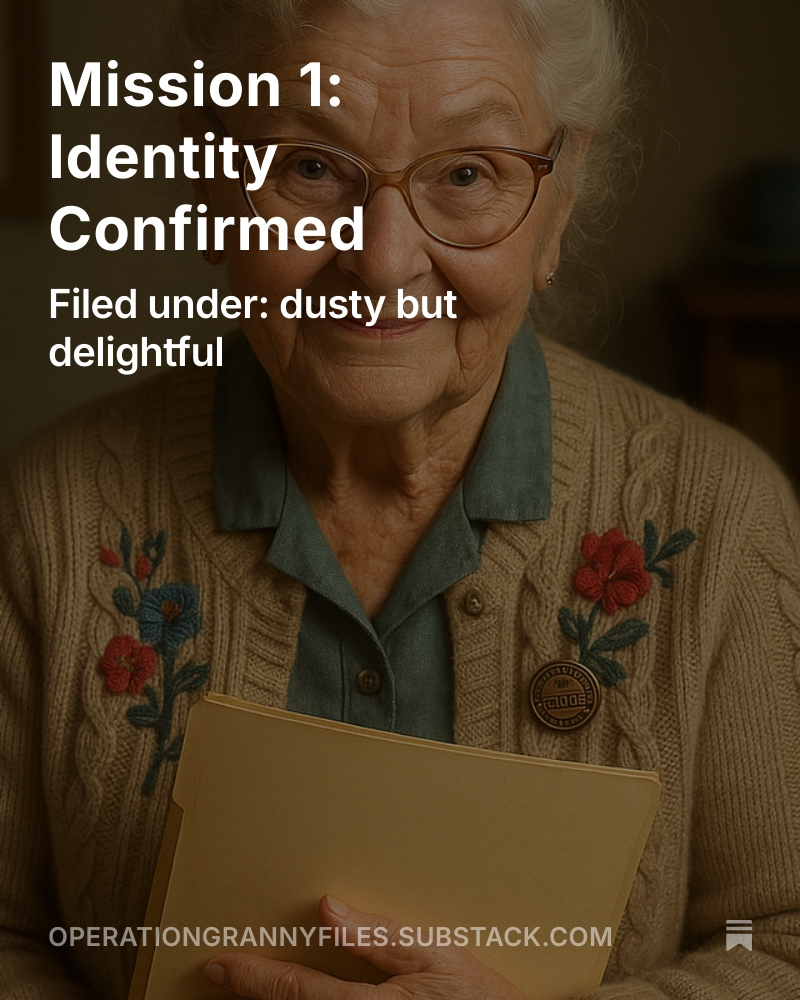
Mission 1: Identity Confirmed
Filed under: dusty but delightful
You don’t need to read Latin.
You don’t need a paid Ancestry account.
You don’t need a grandfather who fought in any particular war.
What you need, agent, is a spark of curiosity, a half-labeled photograph, and one relative who can’t help but spill the family tea after two sips of chamomile.
If you have those three things, you already have everything required to open a Granny File.
Welcome to Operation Granny Files. This is your official briefing.
Somewhere in your house, or your aunt’s basement, or the back of your mother’s closet, there is a tin. It might literally be a biscuit tin. It might be a shoebox marked 1983??? in a hand nobody can quite identify. It might be a manila folder labeled “important” by someone who would never admit they were the family historian.
That tin is a Level-One Clearance Archive. You just didn’t know it had clearance levels.
Operation Granny Files exists to teach you how to read what’s inside it, without judgment, without jargon, and without the magnifying glass (though we do appreciate the aesthetic). Whether you’re an old-school scrapbooker, a digital sleuth, or someone who has recently inherited a shoebox and a vague feeling of obligation, you are in the right place. We don’t care how you got here. We care what you do next.
Between us and the biscuit tin, most family historians start exactly where you are right now: a little curious, a little overwhelmed, and not entirely sure they’re allowed to call themselves family historians yet. You are. Welcome to the field office.
What “Genealogy 101” actually means
This isn’t a single post and a goodbye. It’s a curriculum.
Ten missions take you from I don’t know where to start to I know exactly which record I’m chasing next. Each one is small enough to finish on a Saturday morning. Together, they form a foundation you can stand on for the rest of your research life.
- Mission 1 - Identity Confirmed. You’re reading it. What this is, why it matters, and the one tiny thing you’ll do before Mission 2 arrives.
- Mission 2 - Operation Tea & Tattle. How to draw the juiciest oral histories out of your living relatives without sounding like a census taker.
- Missions 3 through 9. The toolkit: photos, documents, family trees, censuses, vital records, newspapers, neighbors. One mission, one tool, one small win.
- Mission 10 - Capstone. Your blueprint for turning a pile of discoveries into a project you actually finish.
After Mission 10, the briefings keep coming: DNA, immigration, military service, wills, land, church records, court files, and the long shimmering road back into the centuries before the United States even existed. We’ll worry about all that later. Right now, you only need the tin.
How a mission works
Every post in this series gives you four things:
- A story. Because dates without people are just math.
- A tool. A specific record set, technique, or habit you can use this week.
- A downloadable artifact. A clean, printable, college-workbook-quality module to keep on your desk. No pop-up guilt trips. No upsells. Yours.
- An assignment. Small. Doable. Designed to put one new thing in your file before the next mission lands.
Some weeks the artifact will be a checklist. Some weeks a worksheet. Some weeks a reference card you’ll want to laminate and tuck inside the tin. They all share a voice: call her Instructor Granny, who is professional, encouraging, and precise. The companion newsletter brings in her conspiratorial cousin, who prefers a fresh pot of tea and a story.
A word about Cousin Karen
Every family has one. Not literally named Karen, but you know her. She organized one cousin reunion in 2007 and has been The Authority on the family ever since. She has firm opinions about what your grandmother was really like. She is not always wrong. She is also not always right.
You are not trying to replace Cousin Karen. You are quietly building a better archive than hers, because you are going to write things down, ask better questions, and verify what she tells you against the record. She will come around. Most of them do. And if she doesn’t, the cousins on the other side of the family almost certainly will, but that’s a story for another mission.
Mission Download
- Genealogy 101 Starter Guide - A quick-start guide for opening your first family history file and getting oriented before the 101 missions continue.
Your first assignment, agent
Before Mission 2 lands in your inbox, do exactly one thing.
Find the tin.
Don’t open it. Don’t sort it. Don’t catalog it. Just locate it. If it’s at your mother’s, text her. If it’s at your aunt’s, mention it casually next time you call. If it’s already on your shelf, dust it off and look at it for a moment.
That is the whole assignment.
Most people never start their family history because they keep trying to start with everything. We are starting with one tin.
The rest of this series is built on a quiet bet: that ordinary people, given a little structure and a lot of warmth, find out remarkable things about where they came from. We’ve watched it happen. We’re watching it happen now. It is going to happen to you.
GRANNY SAYS: You are not late. You are not under-qualified. You do not need to be related to anyone famous. You need a tin and a question. Both are already in the building.
Mission 2, Operation Tea & Tattle, drops next week. Bring the tin. Bring a notebook. And, agent? Brew the chamomile early.